Fall 2026 Journal of Economic Perspectives Freely Available Online
I have been the Managing Editor of the Journal of Economic Perspectives since the first issue in Summer 1987. The JEP is published by the American Economic Association, which decided back in 2011–to my delight–that the journal would be freely available online, from the current issue all the way back to the first issue. You … Continue reading Fall 2026 Journal of Economic Perspectives Freely…
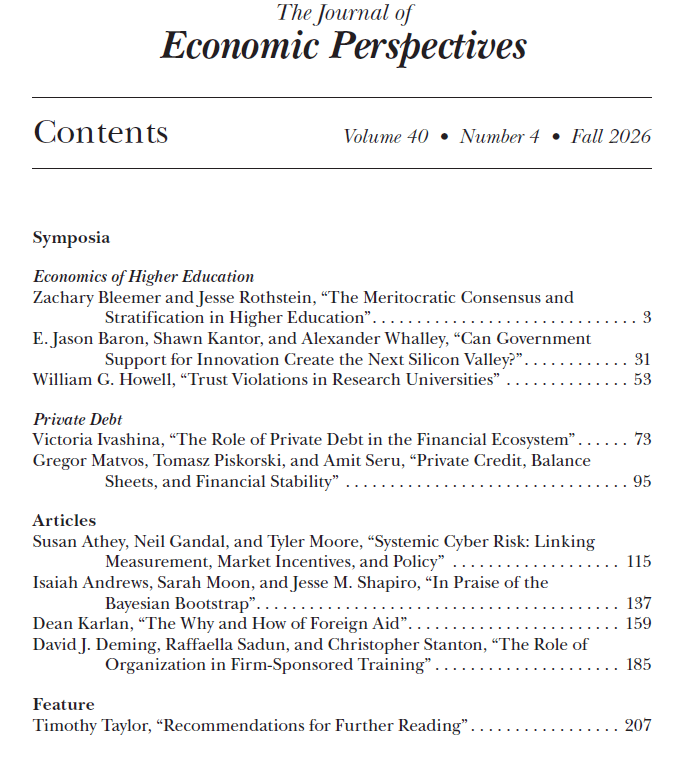
In the Fall 2026 issue of the Journal of Economic Perspectives, published online by the American Economic Association, several papers tackle various economic topics. The issue begins with a symposium on higher education, focusing on the meritocratic consensus and stratification within universities. Authors Zachary Bleemer and Jesse Rothstein explore how colleges that admit high-achieving students, often from affluent families, spend significantly more on instruction compared to institutions with lower-performing students.
They argue that while stratification by test scores has remained relatively stable since the 1960s, the stratification of instructional resources has increased sharply since 1970.
Another article discusses the potential economic benefits of government support for innovation in creating new economic hubs like Silicon Valley. E. Jason Baron, Shawn Kantor, and Alexander Whalley examine the role of public research and development in fostering regional knowledge centers. They conclude that while public R&D can boost innovation, employment, and income, its effects are often modest and may result from the relocation of firms and skilled workers.
The authors emphasize that local inputs, such as entrepreneurs, risk capital, skilled labor, and institutions, play a crucial role in the development of successful hubs.
Trust in research universities has experienced a significant decline over the past decade, according to a study by William G. Howell. Public trust in these institutions has dropped twice as much as in other tracked institutions. Howell identifies two internal sources of trust violations: research driven by political advocacy and a narrowing ideological range among academics, particularly in the humanities and social sciences.
The paper argues that restoring trust requires a renewed commitment to disinterested inquiry and intellectual pluralism, which can be achieved through voluntary adoption of these principles rather than state intervention.
Lastly, the issue includes an introduction to the modern private debt market by Victoria Ivashina. The paper examines the rapid expansion of private debt since the 2007-2009 global financial crisis, noting that "private debt" now refers to credit originated and held by nonbank financial intermediaries, such as private credit funds and business development companies.
Ivashina reviews the drivers of the sector's growth, the unique features of private lending arrangements, and the implications for traditional banking, financial intermediation, and financial stability. Despite the sector's complexity, the paper concludes that private debt represents an important and likely durable component of modern financial markets.
Written by urgent.news from Conversable Economist's reporting — not their text. Machine-written — may contain errors; check the original before relying on it.