Deep Read: „Wir leben in einer Gesellschaft mit blockierten Aufstiegswegen“
Der Soziologe Steffen Mau glaubt nicht, dass der Jugendaufstand lange anhält. Erheblichen Frust sieht er dennoch im Land – die AfD werde davon noch auf Jahre hinaus profitieren.
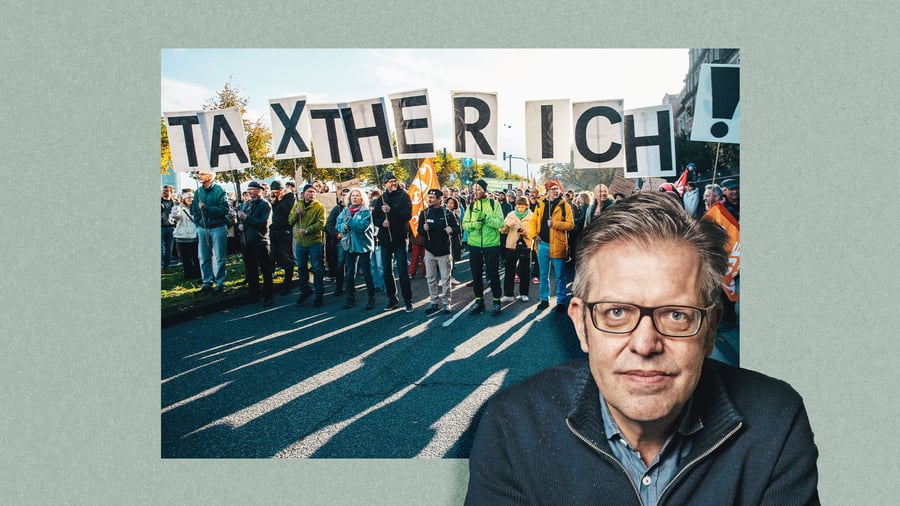
Steffen Mau, the renowned German sociologist, once considered himself an optimist. Unlike others who perceived society as divided, Mau focused on "trigger topics" that fueled debates in Germany. Now, he expressed surprise at the rapid changes he witnessed. Although he does not envision mass protests like those in France, Mau remains certain that Germany, primarily its centrist parties, is in a precarious position.
This precariousness stems from the inability of the Alternative for Germany (AfD) party to gain further momentum. Consequently, Mau initiated a conversation about youth protests, party weaknesses, and the rise of right-wing populism.
Recently, young people across Europe have taken to the streets, and in Germany, this trend has only intensified. Initially, conflicts arose between cities and regions, between globalizers and those left behind, and between the center and the periphery. However, a new generation conflict emerged, involving older and younger generations.
This conflict does not stem from generational differences per se, but rather from a deep-seated opposition to established politics. The youth's disconnection from politics is evident in their values and orientations, as some choose far-right ideologies while others lean far-left. Yet, an underlying frustration is shared among them, fueled by perceived lack of opportunity, insufficient participation in policy-making, and the consequences of artificial intelligence on career prospects.
Furthermore, the disappointment of not achieving a better life than their parents has contributed to this dissatisfaction. The overall conclusion is that Germany lives in a society with blocked pathways to advancement, and young people are grappling with an inability to envision a secure future or career.
The youth protests signify a significant momentum with a unifying aspect; however, Mau warns against expecting a long-lasting political movement. He recalls the protest against the Reichstag in 2021, where young individuals demanded to speak with candidates. They believed that the "Greta generation" would compel parties to adopt different climate policies.
However, this movement quickly collapsed. Mau attributes this collapse to hyperpoliticization, where many issues are discussed intensely, and collective mobilization occurs, but the transition to institutional representation remains elusive. Consequently, protests arise in the spirit of social media, gaining immense attention for a short period before vanishing just as swiftly.
While such protests may not translate into a new form of political organization, Mau remains optimistic about the prospects for alternative political structures. Centrist parties are struggling, and their appeal is limited to rural and mid-sized urban areas. In contrast, the Alternative for Germany (AfD) party predominantly thrives in these regions.
Nevertheless, the conventional centrist parties have strong bureaucracies that prevent the emergence of left-wing or right-wing movement parties. The rise of these new movement parties is primarily due to their strong presence in social media. These platforms have become the primary space for political socialization among the youth, surpassing traditional avenues like youth organizations, trade unions, workplaces, or party youth movements. Affectionate politics on social media platforms plays a significant role in mobilizing the youth.
Written by urgent.news from Handelsblatt's reporting — not their text. Machine-written — may contain errors; check the original before relying on it.
This story
This is one outlet's version. Read the fullest account.
- Deep Read: Two prisoners, a sham apartment and a PwC legal lawyer handelsblatt.com