Analysis: China’s quarterly CO2 falls 3% in largest drop since Covid
China’s carbon dioxide (CO2) emissions fell by 3.1% in the third quarter of 2026, as the Hormuz crisis continued to… The post Analysis: China’s quarterly CO2 falls 3% in largest drop since Covid appeared first on Carbon Brief .
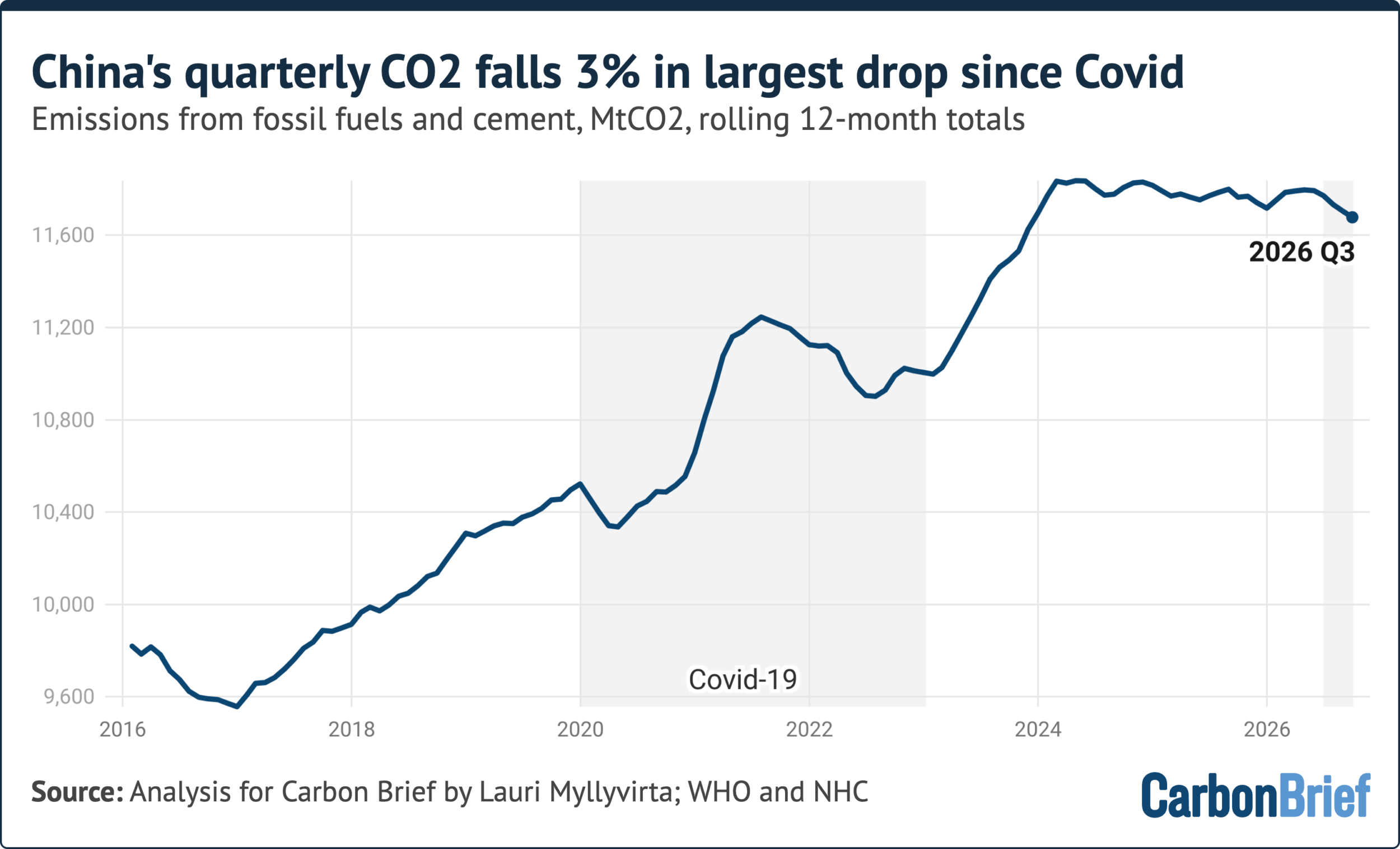
China's CO2 emissions decreased by 3.1% in the third quarter of 2026, marking the largest quarterly reduction since the 2022 COVID lockdowns. This decline, estimated at 0.5% year-to-date, is largely attributed to a 3% drop in coal usage and a 4% reduction in oil consumption. The main contributors to this trend include a significant decline in power-sector coal consumption, a sharp reduction in transport oil consumption, and slowing growth in the coal-to-chemical industry.
Over the past two years, China has experienced a "flat or falling" trend in CO2 emissions, as illustrated in the provided analysis. The outlook for China's CO2 emissions hinges on the interplay between rising energy demand, clean-energy growth, and the government's response to GDP slowdown. The decline in CO2 emissions can be attributed to various factors, including a 3.3% drop in coal-power generation, a 110 terawatt-hour (TWh) year-on-year increase in clean-power generation (primarily from solar, wind, and nuclear), and a 9% decline in transport oil consumption.
Additionally, the coal-to-chemical industry's growth has been slowing due to high coal prices, higher output prices, and reduced construction volumes. Despite ongoing new coal-power capacity development, average running hours for coal plants are falling, resulting in lower profits for the sector. The balance between rising energy demand, clean-energy growth, and government policies will play a crucial role in shaping China's CO2 emissions trajectory in the coming years.
Written by urgent.news from Carbon Brief's reporting — not their text. Machine-written — may contain errors; check the original before relying on it.
Also reported by 1 other outlet
- China sees fastest emissions drop since Covid due to Middle East war freemalaysiatoday.com