Why Does Mumbai Need Desalination Plants Except As Vanity Projects?
Mumbai’s first-ever desalination plant has got many people excited—urban policy wonks about tapping into the seawater that surrounds the city, the Maharashtra government about scoring yet another first, the Brihanmumbai Municipal Corporation (BMC) about going beyond rain-fed reservoirs in the city and dams hundreds of kilometres away, and the Israeli company about the Rs 3,900 crore project at…
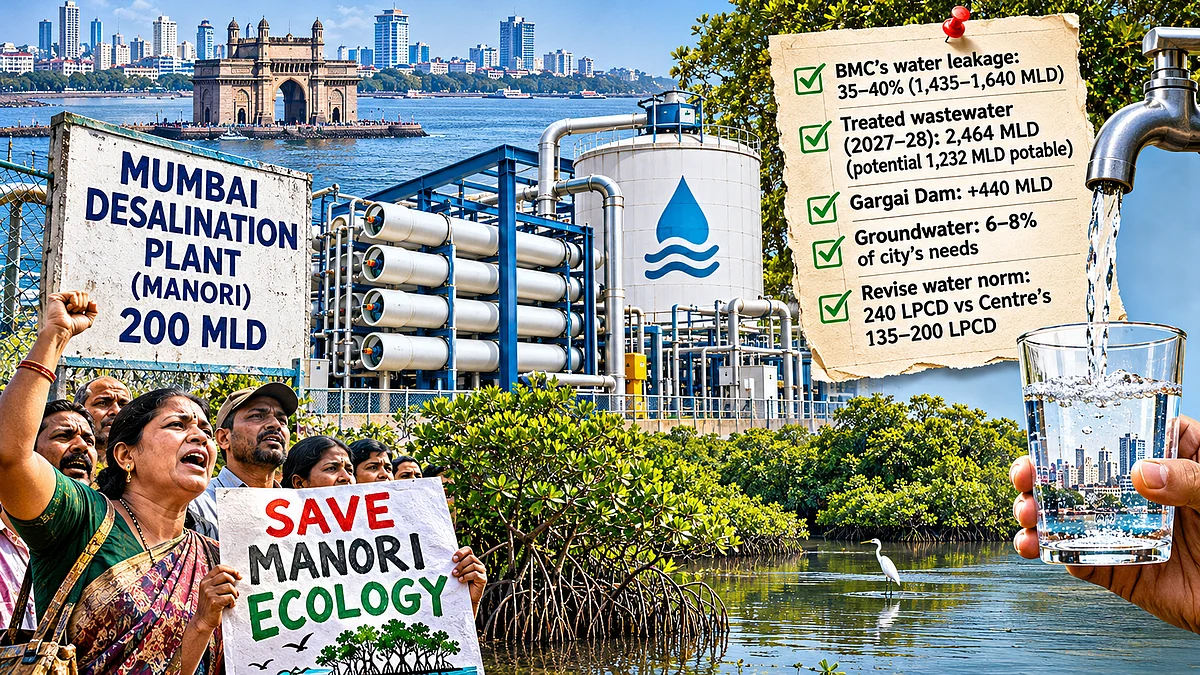
Mumbai's first-ever desalination plant has been met with excitement from various stakeholders, including urban policy experts, the Maharashtra government, the Brihanmumbai Municipal Corporation (BMC), and the Israeli company IDE Technologies. The Rs 3,900 crore project, to be constructed near Manori, will provide 200 million litres a day (MLD) of water using reverse osmosis technology.
The proposed plant is situated in a sensitive coastal zone, and plans to increase its capacity to 400 MLD have been suggested. Locals have protested against the destruction of ecology and their lives, as 971 trees are to be cut in Manori.
Critics argue that the desalination plant is a vanity project rather than a genuine solution to Mumbai's water crisis. Firstly, the city's supply system loses around 35-40% of water, equating to 1,435-1,640 MLD, a figure far greater than the capacity of the Manori desalination plant. Secondly, groundwater sources, often overlooked in water calculations, supply 6-8% of Mumbai's needs, primarily for non-domestic uses.
Thirdly, the BMC is investing Rs 26,000 crore for seven wastewater treatment plants that will provide 2,464 MLD for non-drinking purposes, eliminating the need for desalination plants. Fourthly, the construction of the Gargai Dam in Palghar will add another 440 MLD to the city's water supply. Lastly, the city's per capita water requirement has been calculated based on outdated benchmarks, leading to a perceived shortfall.
As a result, Mumbai does not need to invest in desalination plants or invest thousands of crores in such projects, as the city has more water than it requires.
Written by urgent.news from Free Press Journal's reporting — not their text. Machine-written — may contain errors; check the original before relying on it.