France braces for mass protests as trade unions join student demonstrations
PARIS, Nov 5 — Hundreds of thousands of people are expected to take to the streets across France on Thursday, as u...
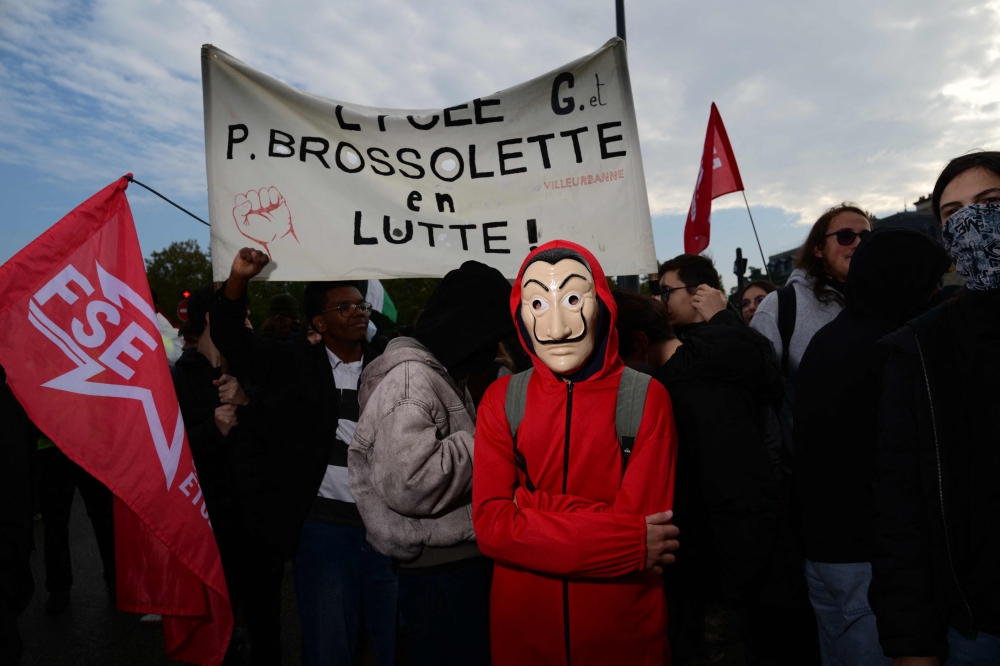
Paris, November 5 - As many as 500,000 to 700,000 people are set to march through France on Thursday, with unions joining forces with student-led demonstrations that have dominated the nation for weeks. The country finds itself grappling with its financial situation, six months before presidential elections, in which the far-right is currently in the lead.
The student movement, which started due to poor learning conditions, has merged with widespread discontent over soaring living costs and inequality. This culminated in the worst rioting in France in years on October 17.
CFDT union secretary general Marylise Leon expressed frustration, saying, "We should be able to make a decent living from our jobs." The unions are demanding a raise in the minimum wage, across-the-board wage increases, tax reforms, and improved educational conditions for young people. Authorities estimate that between 80,000 and 500,000 individuals will protest across the country on Thursday, while around 80,000 are expected to gather in the capital, Paris.
Public and private educational unions, along with those representing rail workers, public hospitals, and postal services, have all called for strike action. Train travel was disrupted on Monday morning, with some delays reported at Paris's Montparnasse train station. Interior Minister Laurent Nunez announced that 70,000 police officers and security forces would be deployed nationwide, vowing to respond "firmly" to any violent acts or disorder.
Interior Minister Nunez promised a "firm response" to any acts of violence or disorder. Dozens of high school students also protested in various cities. In Paris, police used tear gas to prevent students from blocking the Helene-Boucher high school. The protests have largely remained peaceful, although some incidents have led to clashes between students and police, with tear gas and water cannon being used to disperse crowds.
An attempted murder investigation was launched after petrol bombs were thrown at security forces in Paris on Saturday.
The police response has been criticized as heavy-handed, with internal police investigations launched over allegations of brutality against demonstrators. Dozens of teenage protesters were severely injured, and thousands were arrested. Authorities acknowledged security and intelligence failures that allowed the clashes, large-scale looting, and vandalism of public property on October 17 to occur.
On Wednesday, the Paris prefecture banned a major protest route and replaced it with an authorized route that moved away from the city center.
Several unions have denounced the route bans as attempts to suppress freedom of demonstration. In the southern city of Toulouse, a union source confirmed that protesters would march through the city center despite a court upholding a police ban on the route. Fabrice Fort of the CGT union explained, "We can feel a cumulative effect: public sympathy for the high school and university students' movement is not waning, and people are questioning restrictions on liberties, especially bans on demonstrations. This has sparked a wake-up call among people who usually don't speak out much."
Similar protests have erupted in other European countries in recent weeks, with youth-led demonstrations witnessed in Denmark, Germany, and Italy.
Written by urgent.news from Malay Mail's reporting — not their text. Machine-written — may contain errors; check the original before relying on it.
This story
This is one outlet's version. Read the fullest account.