Bustling market in Dhaka shows shift to solar triggered by Middle East war
From the Philippines to Pakistan and Nigeria, people are turning to solar and batteries to cut utility bills or just keep lights and machinery on.
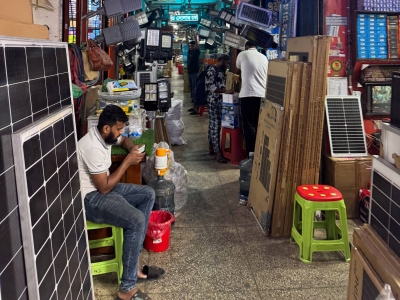
A bustling market in Dhaka, the capital of Bangladesh, has become an unexpected hub for the country's energy transition driven by the war in the Middle East. The narrow aisles of the Kaptan Bazar are filled with solar panels and batteries as demand for the technology surges by 50% compared to a year earlier. The worsening energy crisis, exacerbated by the war, has pushed households and businesses to seek alternatives to an unreliable power grid.
Monju Hossain, a sales representative for Dongjin Group Bangladesh, attributes the increased demand to the rising frequency of blackouts. "The blackouts in Bangladesh have gotten worse, which has increased the need for our equipment," he said. Industrial customers are also demanding more solar solutions to ensure uninterrupted factory operations.
The market showcases how the energy shock from the Middle East is accelerating the shift away from fossil fuels in poorer nations like Bangladesh. Countries such as the Philippines, Pakistan, and Nigeria are turning to solar and batteries to reduce utility bills and maintain power for essential machinery.
This solar surge poses a long-term threat to the demand for liquefied natural gas (LNG), as developing nations with large populations like Bangladesh have been considered high-growth markets for LNG. Bangladesh, home to 180 million people, has been severely impacted by the energy disruptions from the Persian Gulf, with load-shedding (rolling blackouts) lasting up to 18 hours a day in some areas.
To compensate for the shortage, Bangladesh has been purchasing LNG on the spot market at triple the contracted price, leading to higher electricity bills. Prime Minister Tarique Rahman has even installed solar panels on his residence, and informal surveys of the Kaptan Bazar stall owners revealed a significant increase in demand for solar equipment across the country.
China, the world's leading manufacturer of solar panels and batteries, has contributed to this shift. Bangladesh's imports of these products from China more than doubled from $70 million to $140 million between March and September. The average cost of a 750-watt solar panel for a single household is around 15,000 taka ($121), while annual electricity bills are approximately 38,000 taka.
Adding a battery and associated equipment increases the cost by several times, but the payback period for a typical family is around a decade.
The Bangladeshi government has reduced import tariffs on solar equipment since September, aiming for renewables to constitute 20% of the power mix by 2030 and 30% by 2040. Shafiqul Alam, a lead analyst at the Institute for Energy Economics and Financial Analysis, emphasizes that the switch to clean power will reduce the country's vulnerability to future energy crises. However, lower-income households may benefit more from subsidies like India's capital subsidy program.
Some industrialists, like Abdul Hakim, who operates a ceramics factory in Dhaka, have embraced solar technology to reduce their operating costs. While his kiln relies on natural gas for full production, installing rooftop solar has encouraged him to explore expanding into the energy business itself, supplying panels and lithium batteries.
However, some sectors, particularly textiles and garments, face challenges in adopting solar energy. These industries, which are Bangladesh's top exports, rely heavily on gas-fired boilers for steam in their manufacturing processes. Mosharaf Hossain, the chairman of the Mosharaf Group, one of the country's biggest textile producers, explains that solar only generates electricity, not steam, making it unsuitable for their operations.
Written by urgent.news from Japan Times's reporting — not their text. Machine-written — may contain errors; check the original before relying on it.