Nobody Knows Anything, 2026 Midterms Edition
250 House seats, ~55 Senate seats. The past few months have been fascinating, watching pundits wrestle with what turned out to be a historic election. All presidents lose Congressional seats in the midterms (with only 4 exceptions). Given how close the margins had been, a shift in at least the House was likely.… Read More The post Nobody Knows Anything, 2026 Midterms Edition appeared first on The…
Despite the frenzy of late-stage analysis, the reality remains unassailable: in the 2026 midterms, nobody possessed the full picture. The election, a historic one, saw presidents across the board losing Congressional seats—an outcome that transpired four times previously in history. With the race notably close, a shift in the House appeared inevitable.
However, the electorate's polarization was unprecedented. President Trump, who had secured victory in 2024 by appealing to a wide array of voters, notably young males, the uneducated, and Hispanics, created a GOP coalition that was particularly susceptible to the traditional swing dynamics of midterms.
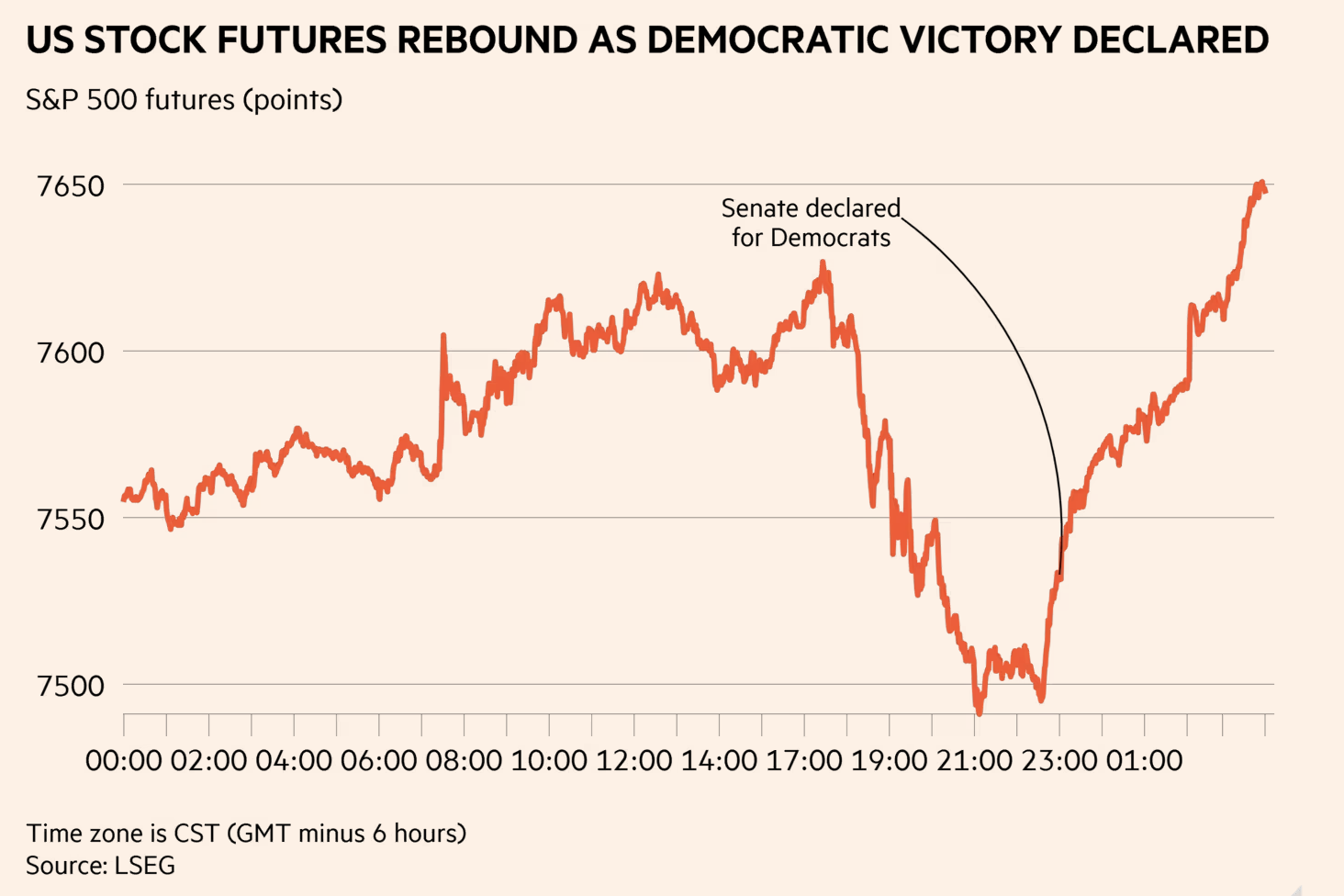
Numerous indicators—stock futures, prediction markets, and polls—all failed to correctly predict the election's trajectory. Stock futures plunged into a deep selloff by early evening; prediction markets undervalued Democratic candidates; polls, which were accurate in direction, significantly misjudged the magnitude of shifts, and misread Democratic victories in historically Republican strongholds.
The S&P 500 fell approximately 100 points, subsequently recovering to a gain of 150 points from those lows. By early today, the Dow and S&P 500 were up by 3% and 2% respectively, marking a substantial rebound from their earlier lows.
The president, formerly the Chief Investment Strategist for a major bank, advised a closer examination of numerical forecasts. Polymarket's gamblers experienced a challenging night, reflecting the broader skepticism towards prediction markets. The FT highlighted this, noting the inaccuracy of such forecasting tools, a critique that echoed my own reservations.
Polling data was notably off the mark, particularly in the magnitude of changes and the extent of Democratic wins in traditionally Republican areas. The "Texas Shock" exemplified this, with Talarico winning a Senate seat by about 10 points and garnering over a million votes, while Gina Hinojosa won the Texas gubernatorial race by 7% and 750,000 votes.
Even red states like Kansas and South Carolina elected Democrats for the first time in nearly a century. The so-called "Shy Trump" voters, purported to be a significant force, vanished, with exit polls showing 43% opposing Trump compared to only 16% supporting him.
Turnout models underestimated the motivation of Democratic-leaning voters, a crucial factor in the election's outcome. Additionally, the president's three signature policies—aggressive immigration enforcement by ICE, a muscular foreign policy supporting ongoing wars, and a haphazard tariff policy—each played a role in shaping voter behavior.
Whenever I invoked William Goldman to underscore the limitations of predicting the future, I felt I was acknowledging a fundamental flaw in human cognition. Our evolutionary past is tailored for survival in a different context—far removed from today's complex social interactions.
This combination of tribalism, a poor information diet, and an inability to accurately assess our own abilities proves disastrous when assessing political events and market dynamics. In essence, the 2026 midterms serve as a stark reminder that "Nobody Knows Anything."
Written by urgent.news from The Big Picture's reporting — not their text. Machine-written — may contain errors; check the original before relying on it.