New Lumina Simulation Reveals How the Early Universe Emerged from the Cosmic Dark Ages
Learn how a new computer simulation is helping researchers unravel the early universe's mysteries.
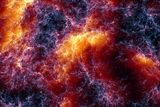
The Cosmic Dark Ages, a period following the Big Bang when the universe was filled with neutral hydrogen and no stars or galaxies had formed, ended around 380,000 years after the initial expansion. The universe slowly transitioned from being dark and cold to becoming filled with light-emitting objects. To understand this transition, scientists have created a new computer simulation called Lumina, which models 2 billion years of cosmic evolution across a vast area of space - 1.6 billion light-years wide.
Aaron Smith, an assistant professor of physics at the University of Texas at Dallas and lead author of a paper introducing the project, expressed great excitement about Lumina. He explained that the simulation can follow the transformation of hydrogen and helium into their modern forms while still resolving the formation of galaxies that played a key role in this transformation.
Oliver Zier, lead investigator on the project and an ITC Fellow at the Harvard & Smithsonian Center for Astrophysics, highlighted the importance of understanding what we are seeing with the James Webb Space Telescope. He stated that to interpret the observations, researchers need detailed predictions from simulations like Lumina.
The simulation focused on the complex universe-wide interactions that drove reionization - the process that turned the universe from dark to bright by knocking electrons away from neutral hydrogen atoms (likely through early stars and galaxies) and by early supermassive black holes (which provided energy for helium reionization). These results offer strong evidence for scientists' theories about the early universe's evolution.
Lumina's capabilities extend beyond solving the mystery of reionization; it will also shed light on the origins and evolution of the first galaxies and black holes. As the simulation is made available to the scientific community, researchers can model scenarios across incredible scales, collaborating to unravel the most mysterious periods in our universe's history.
Written by urgent.news from Discover Magazine's reporting — not their text. Machine-written — may contain errors; check the original before relying on it.