Google liess in Finnland ohne Erlaubnis 530 Hektaren Wald roden. Wie konnte es so weit kommen?
Rechenzentren sollten die marode Wirtschaft Finnlands retten, doch nun formiert sich im Land breiter Widerstand. Die Behörden haben die Arbeiten vorläufig gestoppt. Die Polizei ermittelt.
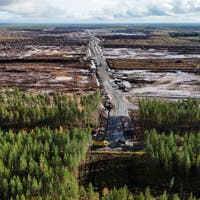
In Finland, Google allegedly cut down 530 hectares of forest without permission, raising questions about how such a large-scale operation could take place without proper authorization. Finnish environmental activists raised the alarm in September, noting that Google had begun large-scale clearances at two locations before the environmental impact assessment was completed.
They reported their suspicions to authorities, prompting investigations. It turned out that Google lacked not only an environmental impact assessment but also a construction permit for its data centers, and the zoning plans were not yet legally binding. The oversight agency halted the work temporarily, but the damage was already done.
The issue extends beyond the felled trees; the topsoil was removed and partially replaced, access roads were built, and trenches dug. Because rainwater couldn't drain, the construction site flooded. The environmental damage cannot be undone. In a country known for its bureaucracy and obsession with state control, this case has sparked outrage.
Finns are asking how such a situation could arise. In early September, hopes were high as Google announced plans to invest 13 billion euros in the country. Local officials in Muhos and Kajaani were overjoyed, describing it as a historic day. However, the excitement quickly turned to anger. The controversy was fueled by new revelations about a case dating back seven years in which Google had felled trees without permits at its Hamina site, destroying the habitat of protected water voles.
Nearly 100,000 people have now signed a petition calling for stricter regulation of data centers, which have already caused controversy in 2018 and 2019. The question remains whether Google acted intentionally or unknowingly, but both the communities and the oversight agency are under scrutiny. The municipal building inspector in Muhos had allowed Tuike Finland, Google's subsidiary, to begin preparatory work for the data centers in the early summer, despite having previously felled large numbers of trees.
When asked about this in an interview with the Finnish newspaper Helsingin Sanomat, the building inspector claimed that Google had pressured him, citing a clause in the building code. However, he eventually gave in to pressure. The oversight agency stated in a letter to Google that the community's authorization does not exempt the company from the obligation to wait for the environmental impact assessment.
However, it raises the question of why the agency did not intervene sooner. The agency had already been aware of the work in Muhos as of August but only responded in October, after environmental activists made the case public. Google claims in a report to the oversight agency that it did not intentionally violate Finnish law and had informed the authorities in advance.
The company stated that it assumed the tree removal in Muhos and Kajaani would be based on the Forest and Building Codes, even though the environmental impact assessment was still underway. The Forest Code only applies if the cleared areas are subsequently replanted, which is not the case for data center construction. The oversight agency and a private individual have filed complaints with the police.
While Finnish legal experts agree that Google has violated the existing laws, Google faces no consequences as the current environmental impact assessment legislation does not include penalties. The government plans to strengthen the law on forest protection. Google has since apologized and promised to plant 130 hectares of new trees in Muhos.
However, it remains unclear whether Google would have been granted permission for the clearances. For nature, the consequences are ultimately irrelevant.
Written by urgent.news from NZZ Wirtschaft's reporting — not their text. Machine-written — may contain errors; check the original before relying on it.