Giant Impacts Help Rocky Planets Retain Their Atmospheres
For a long time, planetary scientists thought that giant impacts drove a young planet's atmosphere away into space with all the heat they generated. But it turns out the opposite could be true. The mass a young planet gains through a giant impact increases its gravitational hold on its atmosphere.
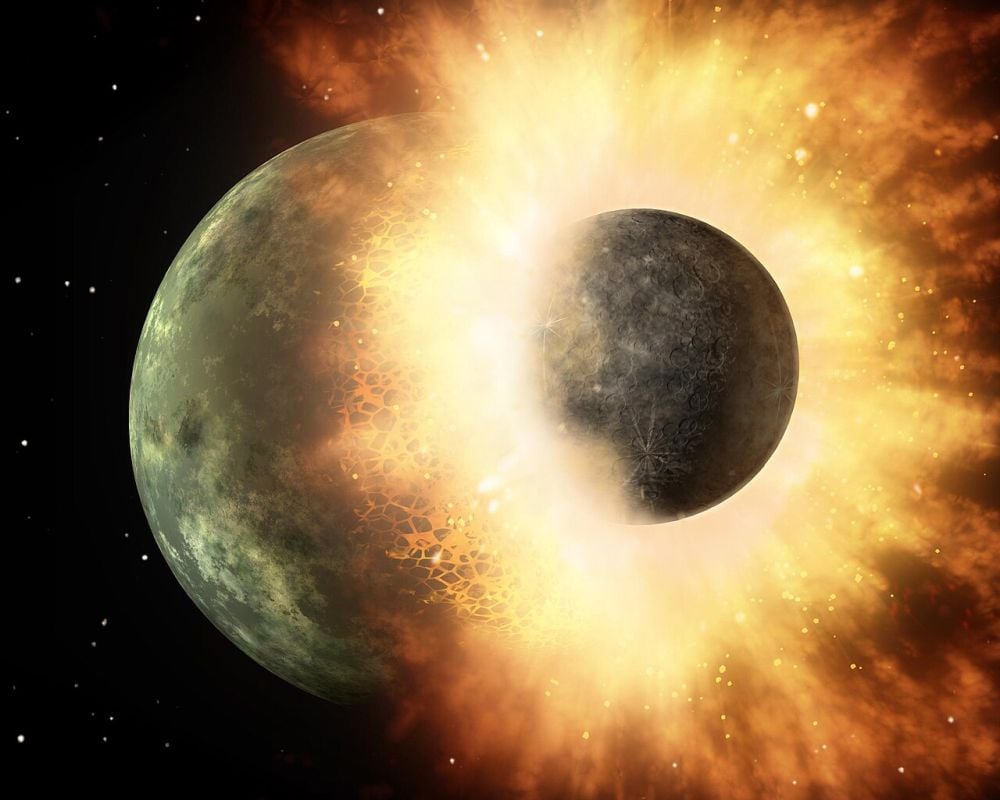
The formation of Earth, around 4.5 billion years ago, was a chaotic process within our young Solar System. Rocky planetesimals collided and merged to create Earth, with massive impacts generating significant heat. Scientists have long wondered how Earth managed to retain its atmosphere near the end of its accretion period. New research suggests that these giant impacts may have played a crucial role in helping young rocky planets keep their atmospheres.
The study, titled "Retention of primordial atmospheres through giant impacts," was published in Nature Astronomy by researchers Darius Modirrousta-Galian and Jun Korenaga. These impacts not only added mass to the planet but also increased its gravitational binding energy, helping the planet hold onto its atmosphere. While the heat from these impacts would typically drive away primordial atmospheres, the mass gained outweighed this effect.
This research could help explain the prevalence of sub-Neptune planets with retained atmospheres in our exoplanet discoveries.
Written by urgent.news from Universe Today's reporting — not their text. Machine-written — may contain errors; check the original before relying on it.