Agent Graph Engineering, Part 5: How to Build Safer AI Agents With Structured Errors and Guardrails
Two edges, one idea: constrain the model declaratively rather than by inspecting what it produced.
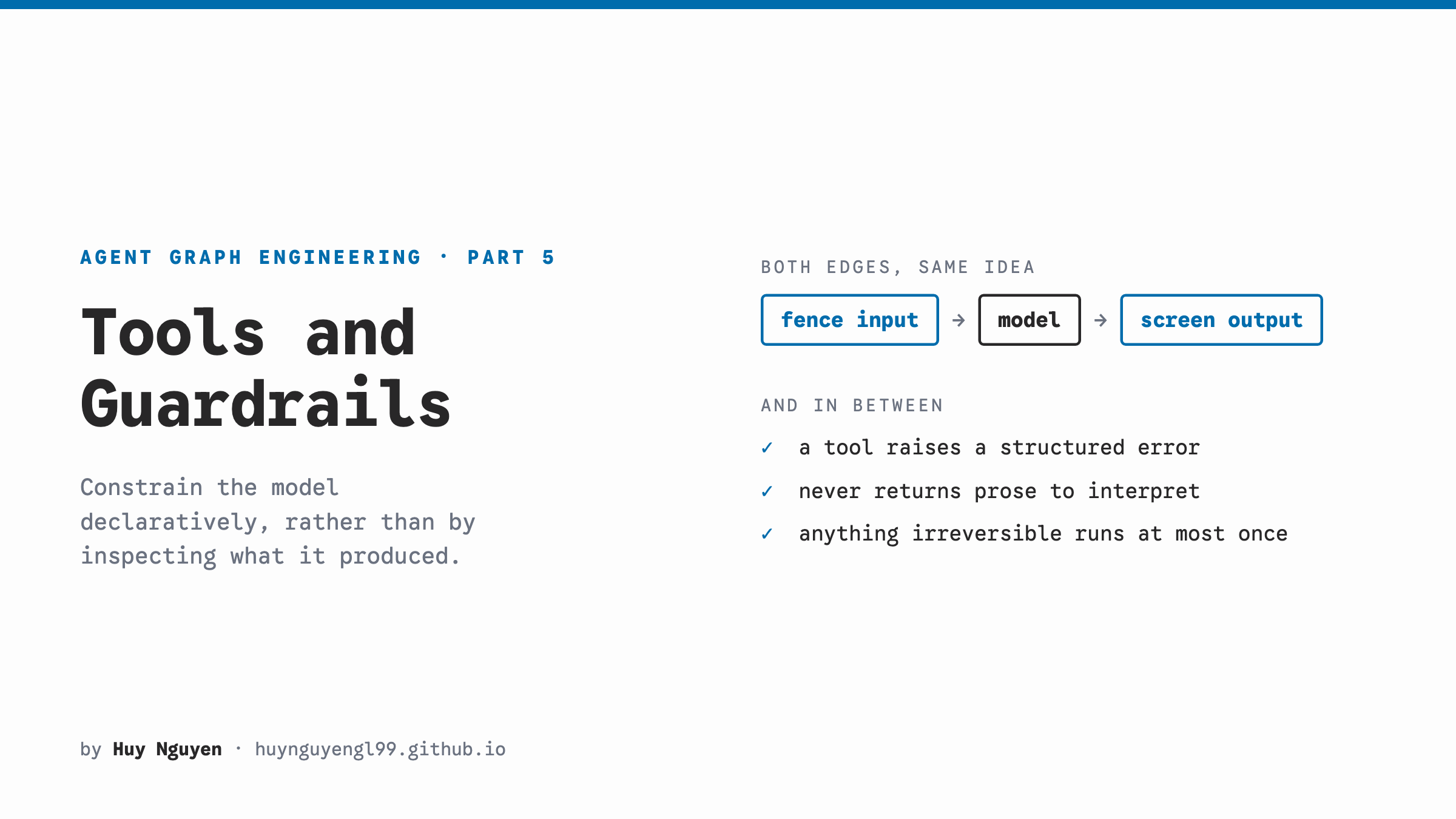
In Part 5 of Agent Graph Engineering, the focus lies on two crucial edges where a model interacts with the external world: the actions it can perform and the things it can communicate. The key idea is to constrain the model declaratively instead of relying on ad-hoc error interpretation within the model's output. This approach involves raising structured errors, rather than returning error strings.
The first edge involves handling errors in a tool. Instead of returning an error message, a structured error should be raised. A decorator is then used to convert these structured errors into a machine-readable format that can be understood by both the model and human users. This separation of error information into two distinct parts—one for the model and one for the user—ensures that neither the model nor the user is presented with unintelligible messages or inadvertently exposed to internal technical details.
The second edge concerns the demarcation and screening of customer-provided data, rather than relying on keyword detection for guardrails. By treating customer-written text as data and enforcing strict input validation, the system ensures that only safe inputs are processed. This approach prevents the model from misinterpreting or mishandling potentially hazardous user inputs.
Furthermore, the concept of at-most-once execution is emphasized for actions that cannot be undone. In cases where a failure occurs, the process should be retried only once, and any subsequent attempts should be treated as a new execution. This prevents accidental duplication of actions, which could lead to inconsistencies and errors in the system.
Overall, these guidelines aim to create safer AI agents by shaping what is possible rather than solely relying on fixing bad behavior through output analysis. By implementing structured errors, clear metadata, and careful data guardrails, developers can build more reliable and trustworthy AI systems.
Written by urgent.news from HackerNoon's reporting — not their text. Machine-written — may contain errors; check the original before relying on it.