Reversing Alzheimer’s disease: nanoparticle platform converts brain cells into new neurons
Reprogramming existing brain support cells into neurons offers a novel way to combat brain degeneration in mice with Alzheimer’s disease The post Reversing Alzheimer’s disease: nanoparticle platform converts brain cells into new neurons appeared first on Physics World .
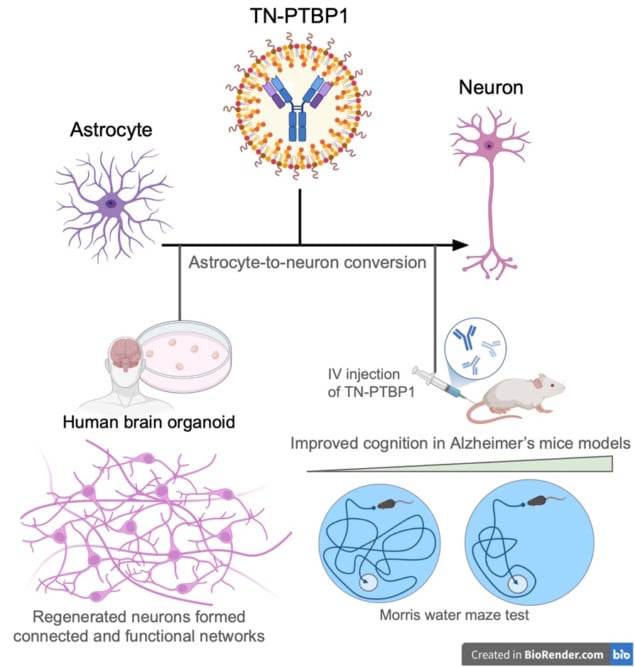
Alzheimer's disease poses a significant challenge in treating patients, as neurons forced into programmed cell death result in cognitive decline and loss of neuronal circuits. Current therapies only aim to slow down neuronal degradation, failing to replenish the loss. A new study published in Cell Biomaterials introduces a novel approach by converting existing brain cells into new neurons, potentially reversing the disease.
Led by Peisheng Xu at the University of South Carolina, the research team utilizes their Nano-ERASER platform, a polymer nanogel that carries antibodies across the blood-brain barrier to specific brain cells. By targeting an antibody that binds to the PTBP1 protein found within astrocytes, the team reprograms the brain to make new neurons, a process known as astrocyte-to-neuron conversion.
Astrocytes, abundant in the brain and responsible for supporting neuronal function, suppress genes that would otherwise push them into becoming neurons. Reducing PTBP1 levels nudges astrocytes to transform into neurons. The Nano-ERASER platform overcomes the challenge of targeting astrocytes without affecting PTBP1 in other tissues by using antibodies as specific markers for PTBP1.
The antibodies, once inside astrocytes, mark the tagged PTBP1 for destruction, driving astrocyte-to-neuron conversion without permanent genetic alterations. The researchers tested the TN-PTBP1 treatment in vitro and in human brain organoids, successfully converting astrocytes to neurons and regenerating neural networks. Additionally, TN-PTBP1 improved cognition in mice with Alzheimer's disease.
The treatment not only replenished lost neurons but also reduced brain inflammation and amyloid-beta buildup, another hallmark of Alzheimer's disease pathology.
Written by urgent.news from Physics World's reporting — not their text. Machine-written — may contain errors; check the original before relying on it.
This story
This is one outlet's version. Read the fullest account.