Lebensader für Blatten: Eine neue Seilbahn erschliesst das Ende vom Lötschental – und sie ist typisch schweizerisch
Wo andere Länder Strassen bauen, setzt die Schweiz auf kleine Bergbahnen. Der Weg durch die Luft hat Vorteile, so auch nach der Katastrophe von Blatten. Trotzdem fehlt vielen Betreibern das Geld.
In the Lötschental, a new cable car has emerged to reconnect the once-destroyed village of Blatten. Unlike other countries that build roads, Switzerland relies on smaller mountain railways, such as the one in Wiler. Despite financial constraints, the operators continue to persevere. The resurrection of Blatten began with a diesel engine's hesitant hum, pulling a thin wire onto a pulley.
The motor and wire stop several meters apart, repeating this process until the construction site near Wiler, just before the former Blatten. This autumn day on the construction site is a race against time, as massive masses of rubble and debris still cover the valley floor. However, something is happening higher up on the slope.
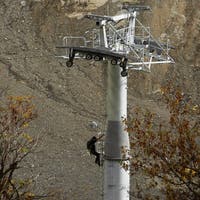
Three masts of the new cable car stand erect, opposing the scar left by the landslide. Like outstretched middle fingers, they stretch out from the valley bottom, emphasizing the message: "We will remain." The Talstation, located in Wiler, is powered by a diesel engine, while the cable is drawn from the Talstation to the Bergstation and back, with three increasingly thick wires connecting the stations.
Markus Menzi, the CEO of cable car manufacturer Bartholet, emphasizes the importance of preserving their alpine cultural heritage. He notes that such situations like the one in Blatten may become more common due to climate change and melting permafrost, making it necessary for people to adapt to mountain living. The new cable car will lead from Wiler up to Weissenried, a settlement directly above the debris pile, and then descend to the remains of Blatten and the end of the Lötschental.
Previously, Blatten was connected to the valley by a road that led down the slope, causing damage to both Weissenried and Blatten. After the catastrophe, the canton of Wallis built a narrow and exposed emergency road from Lauchernalp to Weissenried and then down to the remains of Blatten. This road is now the only link to the end of the Lötschental; even a small post vehicle navigates the dangerous avalanche-prone area and can only be used in the winter.
The canton opted for the cable car to provide year-round access to Weissenried, Blatten, and the valley. This lifeline through the air will allow the 30 residents of Weissenried to rebuild their homes by Christmas. Last winter, they had to be evacuated to the Wallis valley. Only in February did Bartholet receive the contract for the cable car.
Typically, planning and building such a railway would take at least three years, with a nine-month planning permit being the norm in Switzerland. However, Wallis granted the permit notarially, despite the cable car being entirely new and not replacing an existing structure. This unique venture is a Swiss speciality: a small pendulum cable car with two eight-person gondolas.
One gondola descends into the valley while the other ascends to the mountains. This type of small cable car is much more common in Switzerland than in other Alpine countries, with Reto Canale counting around 200 in the nation. Canale, a cable car engineer and industry consultant, attributes Switzerland's success to two factors: the challenging mountainous topography and early pioneers who pushed the development of these simple systems.
The advantages of small cable cars include easy access to remote locations. In the late 19th century, many mountain huts were only reachable on foot via trail paths. Small cable cars revolutionized access to these remote alpine settlements.
Written by urgent.news from NZZ Wirtschaft's reporting — not their text. Machine-written — may contain errors; check the original before relying on it.