Halbleiter: Bosch gliedert Chipsparte aus – Umsatzziel: fünf Milliarden Euro
Bosch-Chef Christian Fischer macht den nächsten Schritt im Konzernumbau. Die Chipsparte wird eine eigene Einheit. Der Konzern will von einem boomenden Geschäft profitieren.
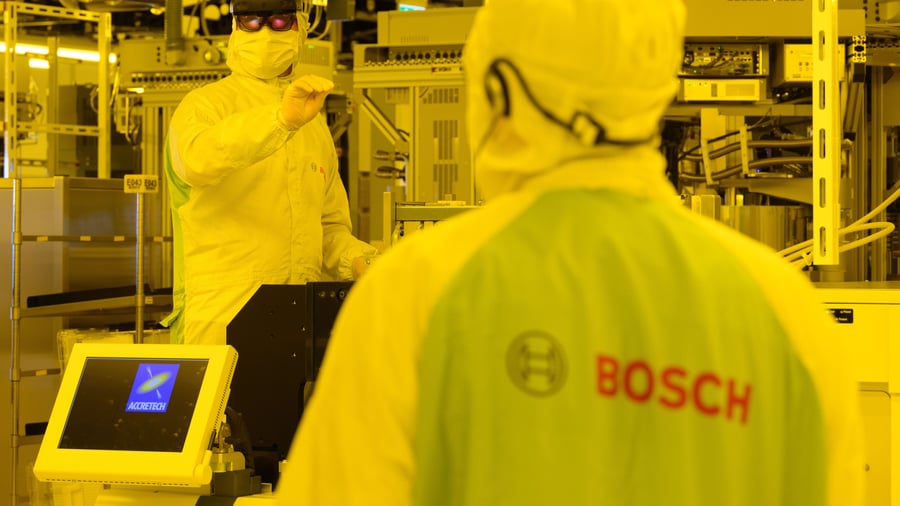
Bosch has recently restructured its corporate hierarchy, separating its semiconductor business into a standalone unit. The company aims to significantly expand the chip sector and targets a revenue of around five billion euros by 2030. This new structure is expected to open up opportunities for partnerships with companies that can provide expertise or financial investments.
Erik Rein, responsible for the semiconductor division at Bosch, stated that creating an independent unit marks a new chapter in the company's over 60-year history in semiconductor technology. The semiconductor segment is projected to generate double-digit revenue growth, with the company's two largest and most volatile sectors being automotive parts and household appliances.
The new business unit is set to launch on January 1, 2028, as announced by Bosch on Tuesday. The division, initially located in the "Mobility Electronics" sector, aims to explore new markets such as robotics and artificial intelligence (AI) data centers. Over the years, Bosch has invested approximately three billion euros in its German facilities in Dresden and Reutlingen, and around two billion dollars in its California manufacturing site, Roseville.
The company acquired a 40-year-old semiconductor site in the US from TSI Semiconductors in 2023. In the US facility, Bosch plans to manufacture and test silicon carbide (SiC) chips on 200-millimeter wafers. The commercial production in the US is expected to begin by 2026. A wafer refers to a cylindrical slice from which chips are produced, with a diameter of 200 millimeters being a high value.
SiC chips are primarily used in data centers driving the AI boom, beyond the automotive sector and solar panels. Bosch is capitalizing on the rapidly growing demand for semiconductors. The semiconductor division has been one of the key investment focuses for the group, with Bosch claiming to have around 40 semiconductor sites globally for research, development, and manufacturing.
Additionally, Bosch plans to expand the test center in Penang, Malaysia, by the middle of the next decade. The company also holds a 10% stake in the European Semiconductor Manufacturing Company (ESMC) joint venture in Dresden. Despite these investments, Bosch's semiconductor division is comparatively smaller than other chip companies.
Infineon, according to the company's own forecast, generated revenues of around 16 billion euros in the previous fiscal year (ending September 30). The Munich DAX company is the global leader in automotive chips and the largest semiconductor manufacturer in Europe. Siemens spun off its semiconductor division, the current Infineon corporation, 27 years ago.
According to a recent McKinsey study, the demand for applications of generative AI alone is expected to reach up to 3.6 million semiconductor wafers by 2030, indicating a significant increase in semiconductor demand. According to a recent ZVEI (German Association for Electrical, Electronic & Information Technologies) analysis, semiconductor demand in Europe is set to double by 2040 due to growth in robotics and industrial automation.
Bosch aims to participate more actively in this growth and reach a semiconductor revenue of around five billion euros by 2030. The company does not disclose its current semiconductor revenue, as most of the chips are currently used for Bosch's own products, such as control units and automotive electronics, and the company prefers not to engage in internal cost accounting with competitors.
In the MEMS (Micro-Electro-Mechanical Systems) product group, Bosch has also managed to secure revenue potential outside the group. MEMS are tiny components that combine micro mechanical structures and electronic circuits on a single silicon chip. Bosch's MEMS technology, with its patents and manufacturing processes, is considered leading worldwide.
Bosch claims that MEMS are present in one out of every two smartphones. Bosch's CEO Christian Fischer, who took over his position in mid-year, had previously announced that he aims to make the group more profitable. In his first interview with the Handelsblatt, he stated, "I want to radically simplify Bosch." More: New CEO at the world's largest automotive supplier: "That will be the biggest change under my leadership"
Written by urgent.news from Handelsblatt's reporting — not their text. Machine-written — may contain errors; check the original before relying on it.