Gebrauchtwagen-Check: Wo der Fiat Panda patzt
Klein, praktisch und vergleichsweise günstig: Der Fiat Panda hat einige Vorzüge. Doch als Gebrauchtwagen hat der kleine Italiener auch manche Macke, zeigt die Tüv-Statistik.
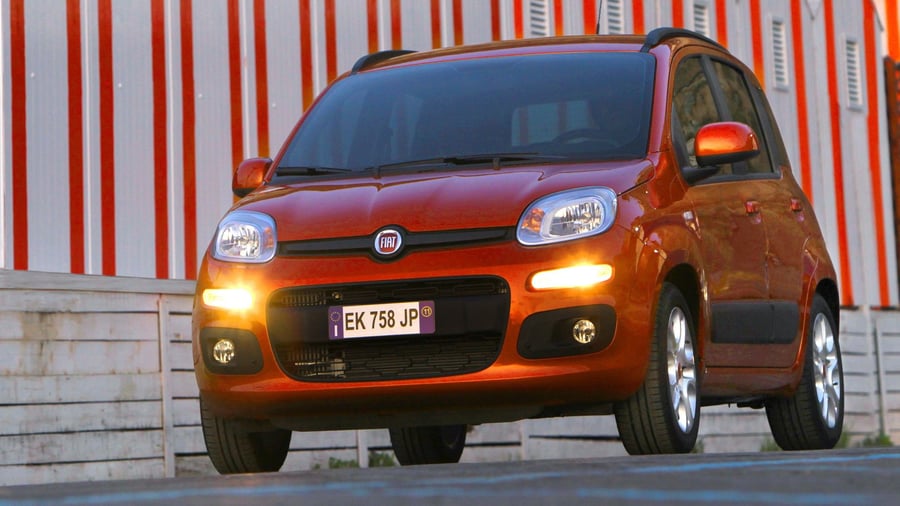
The Fiat Panda third generation entered the market in early 2012, but was already an updated version at that time. The compact car has been on the market for nearly two decades. Its enduring popularity stems from strong sales figures. It is one of Fiat's key models. Consequently, it received a technical update in 2024 to meet European Union safety requirements.
Now, it is referred to as Pandina. Prospective buyers should examine their desired model closely and not overlook subpar mileage. Numerous weak points in the small car are highlighted in the TÜV main inspections. Experts frequently criticize the exhaust system, oil leaks, suspension components, lighting and braking systems. The body and interior design are described as shabby across all generations since its launch in 1980.
The third generation does not deviate from this observation. Overall, the Panda appears rather shabby, emphasized by prominent front and rear overhangs and small wheels. For a more rugged appearance, cross models are available. They have a rustic look due to plastic cladding on the wheels. Despite its 3.65 meter length, the Panda offers ample space and a comfortable interior.
The boot volume varies from 225 to 870 liters depending on the position of the rear seat. Those who value flexibility may look for models with a split rear seat. The Panda's coziness depends on the first buyer and their budget. Depending on the equipment variant, the interior appears very frugal or colorful and modern. In model year 2021, the Panda received a subtle facelift, including a slightly altered front and a modern infotainment system in the interior.
Fiat initially offered gasoline, diesel, and CNG variants; additionally, both front-wheel and all-wheel drive were available. Until the end of 2020, the base engine was a 1.2-liter four-cylinder gasoline with 51 kW/69 PS. For those seeking more power, the 0.9-liter turbo with 66 kW/90 PS (since 2018: 63 kW/86 PS) was available until mid-2022, serving also as the basis for the CNG variant with 59 kW/80 PS or 52 kW/70 PS.
The turbo also lay the foundation for the CNG variant with 59 kW/80 PS or 52 kW/70 PS. The turbocharged two-cylinder and the two 1.3-liter diesel engines with 55 kW/75 PS and 70 kW/95 PS were available with all-wheel drive. The diesel engines (consumption: 3.6 to 4.7 liters) were discontinued in 2018. Fiat currently only offers a 1.0-liter three-cylinder with 48 kW/65 PS and mild hybrid assistance.
The gasoline engine's consumption ranges between 4.1 and 5.8 liters. Equipment and safety were kept minimal to keep the original starting price under 10,000 Euros. Lounge models had slightly more comfort. Optional extras included fog lights, underbody protection for all-wheel-drive vehicles, 15-inch lightweight wheels, cloth seats with leather applications, panoramic roof, and ESP.
ESP was first introduced as an option in 2014. Notably, the small Fiat was one of the first models in its class to feature a city braking system. In summary, the third-generation Fiat Panda offers many practical features but struggles with many aspects in the main inspections. Prospective buyers should have their desired model examined for weak points.
A polished appearance, a complete service booklet, and a fresh TÜV sticker can build trust beforehand. Currently, around 1,000 used third-generation Panda models are listed on mobile.de, starting at around 2,000 Euros.
Written by urgent.news from Handelsblatt's reporting — not their text. Machine-written — may contain errors; check the original before relying on it.