Aurora Images Taken by Stargazers May Help Explain Elusive Red Northern Lights
Learn how photos of a rare aurora over Germany offer new clues to what makes the northern lights glow red.
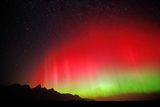
On May 10, 2024, Sami Solanki, a solar physicist, stepped outside his home in Göttingen, Germany, with a camera. He wasn't pursuing scientific research but rather hoping to capture an unusual sight. Two photos taken that night show bright, continuous rays of light running from a red glow into a green one below. A new study published in Annales Geophysicae suggests that fast electrons from space are the likely cause of these "red-green auroras."
These auroras are challenging to study, as they form in thin air high up in the atmosphere, leaving researchers to rely on ground-based photos for clues. Solanki, who directs the Max Planck Institute for Solar System Research, was simply a spectator that night, excited to photograph the rare auroras over Göttingen. "I’ve seen many auroras at higher latitudes. Above Göttingen, they’re a rarity," he said.
The magnetic storm that night, the second strongest since 1958, was strong enough to push auroras far from their usual polar regions. Two photographers captured the phenomenon: Philipp Schulz of a Fraunhofer research institute in Braunschweig and Solanki. Their photos showed bright streaks extending from the red glow down to the green one, a phenomenon never reported before.
Both colors, red and green, come from oxygen atoms that glow after being hit by electrons. The red glow occurs roughly 125 to 500 miles up, where the air is thin enough for the glow to persist. However, scientists have long debated the cause of the red glow, with explanations ranging from heat flowing down from space to waves that speed up electrons. The unbroken streaks in the new photos argue against several of the older theories.
According to Yasuhito Narita, a professor at the Technical University of Braunschweig, the fact that the bright rays extend from the red to the green aurora suggests the same physical process is at work in both. The authors of the study, which rests on a handful of photos taken during the storm, are calling it a "citizen science report" and are urging people to submit more photos taken with a shutter open for 6 seconds or less to help them understand the phenomenon better.
Written by urgent.news from Discover Magazine's reporting — not their text. Machine-written — may contain errors; check the original before relying on it.