Ancient star collisions could explain mysterious Little Red Dots and 'impossible' black holes
Collisions between stars in the early universe were common, and this could explain the growth of supermassive black holes and the existence of strange Little Red Dots seen by the James Webb Space Telescope.
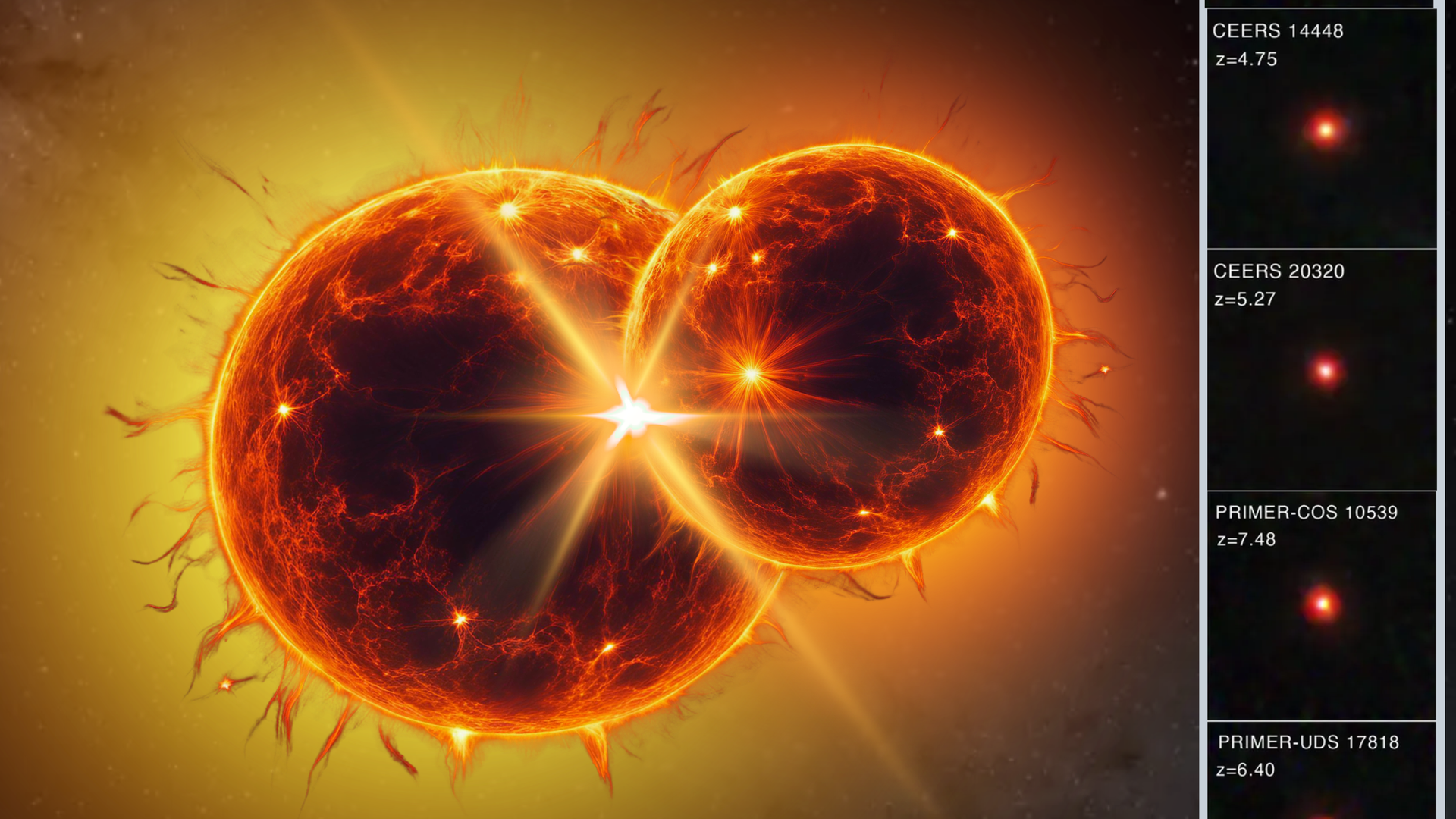
New research proposes that collisions between stars in the early universe were frequent, potentially explaining the rapid growth of supermassive black holes and the presence of peculiar Little Red Dots observed by the James Webb Space Telescope (JWST). The research team conducted simulations of the early universe and discovered that star systems were densely packed, resulting in stars colliding frequently.
Although catastrophic collisions would destroy the stars involved, slower collisions would lead to repeated mergers, forming single, massive stars that could collapse and create over-massive black holes at the end of their lives. These could serve as the progenitors of the first supermassive black holes. While dense stellar environments still exist in the modern universe at the centers of galaxies, they are not conducive to the specific types of collisions that give rise to ultra-massive stars due to the presence of supermassive black holes at the hearts of modern galaxies.
These massive gravitational forces cause colliding stars to move at high speeds, preventing the birth of massive stars. Interestingly, the simulations suggest that stars can merge repeatedly within clusters until they form one giant star with a mass equivalent to the entire cluster. When such a massive star reaches the end of its life, it may collapse into a massive black hole.
The existence of supermassive black holes before the universe was just 1 billion years old has puzzled astronomers since the discovery of these black holes by the JWST in 2022. One proposed explanation is that supermassive black holes don't start from scratch but instead form from intermediate-mass black hole seeds. These seeds can emerge from environments of dense star clustering, as indicated by the new simulations.
The same dense environments that create these black hole seeds could also provide stars and gas that influence their subsequent growth. The team's research, published on Monday, offers a potential solution to the mystery of supermassive black hole growth and the enigmatic Little Red Dots by suggesting that dense star clusters could be the birthplace of intermediate-mass black holes.
Written by urgent.news from Space.com's reporting — not their text. Machine-written — may contain errors; check the original before relying on it.