The solar system may have a sixth dwarf planet, hidden against the Milky Way
For now, the object announced by the Vera C. Rubin Observatory team earlier this week only goes by its provisional designation, 2026 ED138. It currently sits about 46 astronomical units from the Sun. Pluto, by comparison, averages around 40. Read Entire Article
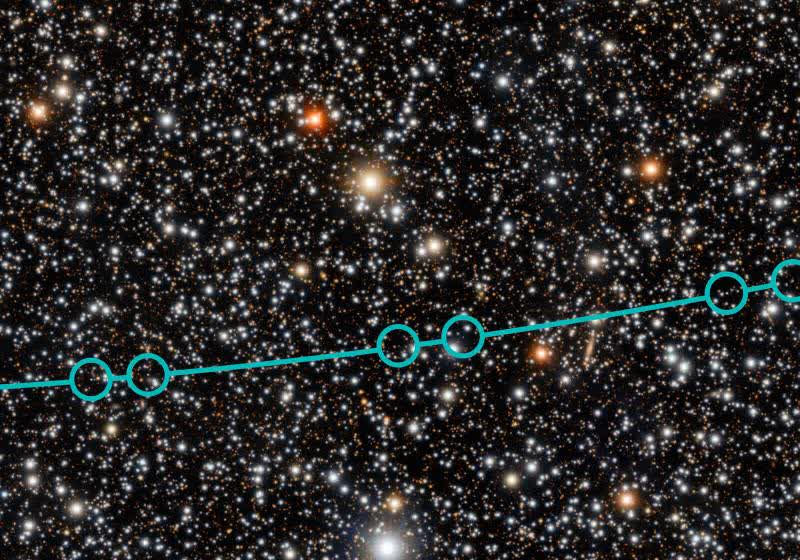
The solar system may soon have a sixth dwarf planet, according to astronomers at the Vera C. Rubin Observatory in Chile. Last week, the team announced the discovery of a new icy world, designated as 2026 ED138, which could be the largest object found past Neptune in about two decades. At present, its official status remains uncertain, labeled only by its provisional designation.
At a distance of approximately 46 astronomical units from the Sun, ED138 is significantly farther out than Pluto, which averages around 40. The exact size of the newly discovered object remains unknown, but astronomers estimate it ranges from 600 to 1,500 kilometers across. This places it in the same size category as Ceres, the smallest currently recognized dwarf planet in the solar system.
The reason ED138 has remained hidden for so long is due to its location in the sky. From Earth, it lies close to the plane of the Milky Way, making it a faint dot among millions of background stars. Rubin's observatory, however, photographs the entire southern sky every few nights using the largest digital camera ever built for astronomy. As a result, the same faint dot keeps appearing in different positions over time, eventually catching the attention of astronomers.
In October, Harvard & Smithsonian astrophysicist Matthew Holman spotted ED138 while analyzing data from earlier that year. Using a search code created with colleague Kevin Napier, Holman noticed the object's unusual brightness, which led him to question whether his equipment had malfunctioned. Jurić's subsequent search through Rubin's catalog confirmed that the object had been visible in 30 images captured over 20 nights between March and July.
Even older survey images show its track dating back to 2016, providing further evidence of its existence.
To officially classify ED138 as a dwarf planet, astronomers need to determine its size more accurately through infrared observations. This will help confirm whether its gravitational pull is strong enough to shape it into a round object. Even after this confirmation, the International Astronomical Union would still need to add ED138 to its official list, a process that could take some time. For now, anyone interested can track ED138's orbit in 3D using the Orbitviewer tool.
Written by urgent.news from TechSpot's reporting — not their text. Machine-written — may contain errors; check the original before relying on it.