From Rally To Rout: Why India’s Equity Market Continues To Bleed
Two years ago, the Sensex fired to an impressive 85,000 for the first time, but since then the market has been in a steep and prolonged decline. What seemed like a roaring bull market around September 2024 soon lost the momentum and plunged around 16 percent to hit a low of 71,425 in April 2025 as Donald Trump’s trade flip-flops and other factors dampened sentiment. But again, the Sensex soared…
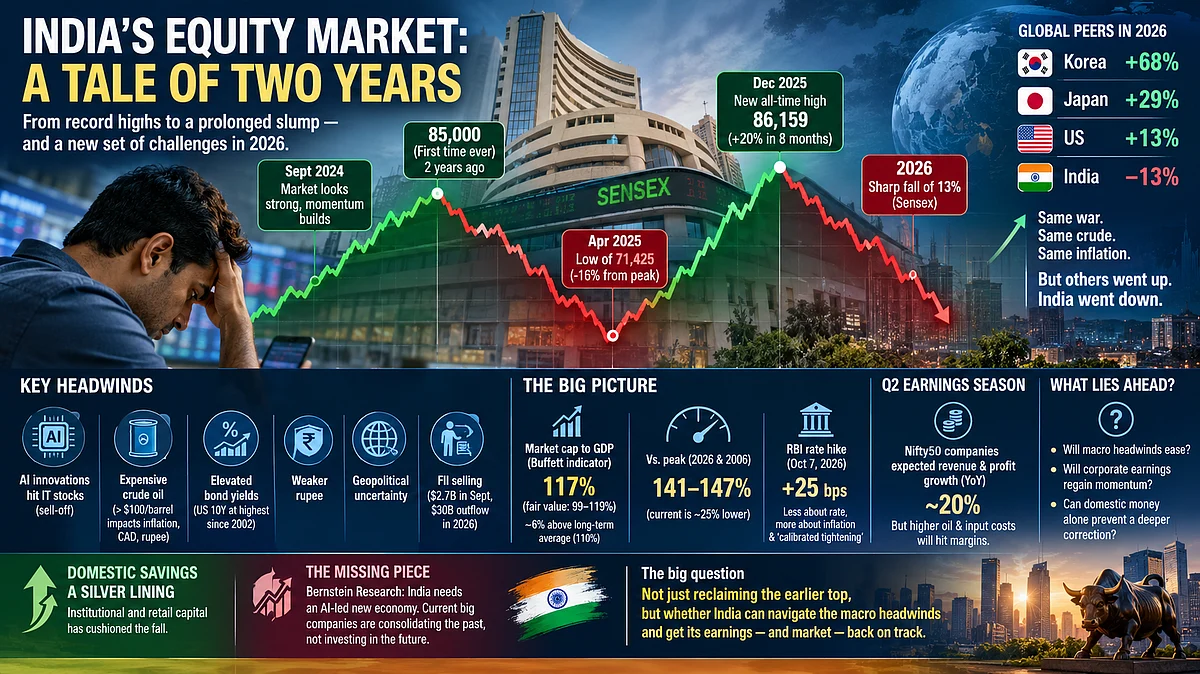
India's equity market has experienced a steep decline over the past two years, despite the country's economy growing at a robust 7 percent rate. The market rallied to an impressive 85,000 for the Sensex in 2024, but since then, it has struggled to regain momentum. The market dipped around 16 percent to hit a low of 71,425 in April 2025, only to soar 20 percent in eight months to reach a new all-time high of 86,159 in December 2025.
However, the optimism was short-lived as AI innovations sparked a sharp sell-off in India's IT stocks in early 2026, and multiple headwinds have kept the market in a grinding state of high volatility and little or no gains.
The market's decline is puzzling given that India's economy is growing at a commendable rate, despite facing challenges like global energy shocks, tariff uncertainties, high interest rates, and a weaker rupee. The correction can be attributed to a combination of factors such as expensive crude, elevated bond yields, a weaker rupee, geopolitical uncertainty, and continued Foreign Institutional Investors (FII) selling.
Foreign investors have been pulling out money from Indian equities, with FII pulling out $2.7 billion in September alone. This has led to the market capitalization-to-GDP ratio exceeding 117 percent, which is considered fair value based on historical benchmarks.
The ongoing correction has taken a toll on retail investors who have seen their wealth decline significantly. Market analysts suggest that the correction is a result of a phase of price and time correction rather than a price correction. The immediate test for the market's direction is the ongoing Q2 earnings season, where consensus estimates predict a 20 percent year-on-year revenue growth for Nifty50 companies, but higher oil prices and input costs will impact profit margins.
The key question now is whether the macro headwinds will subside and corporate earnings will regain momentum.
Written by urgent.news from Free Press Journal's reporting — not their text. Machine-written — may contain errors; check the original before relying on it.