Fish pay attention to one influential neighbour in virtual reality
Observing interactions between real and virtual rummy-nose tetra fish shows that, within a group, each individual takes cues from only one influential neighbour
A virtual reality experiment with fish suggests that each individual may concentrate on just one influential neighbor. This discovery could provide insight into how animals coordinate in groups without being overwhelmed by the surrounding activity. Fish often school together, moving in a coordinated manner, but the mechanism behind their collective behavior remains unclear.
Guy Theraulaz from the University of Toulouse, France, and his team aimed to investigate this question by employing virtual reality (VR) to study the interactions among five rummy-nose tetra fish (Hemigrammus rhodostomus). Theraulaz explains, "A fish in a group can perceive numerous individuals simultaneously, yet perception does not equate to influence."
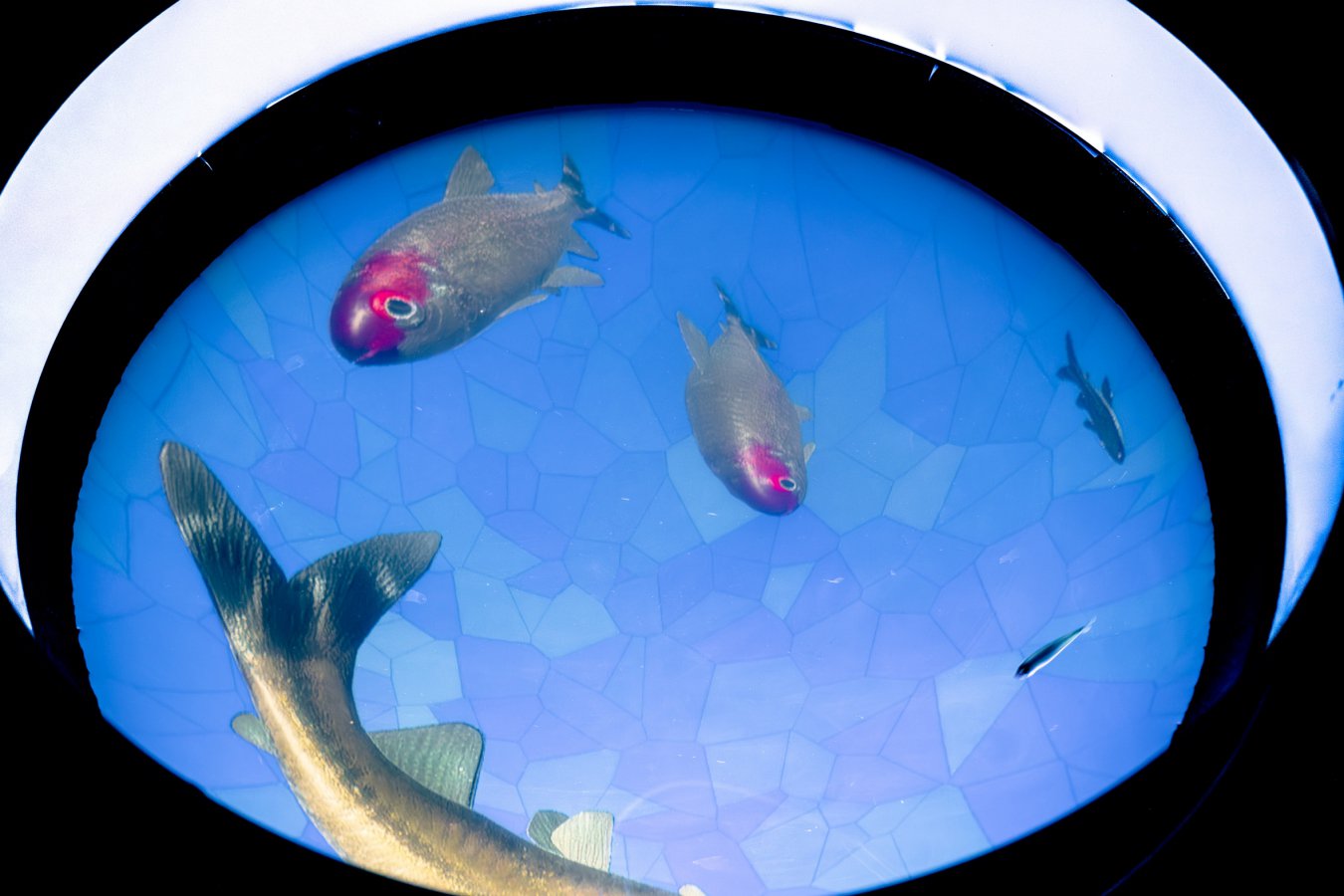
The researchers placed a single tetra in a hemispherical bowl and monitored its movements with a camera. Virtual tetras were projected onto the bowl's interior, creating a realistic environment for the real fish through a feedback loop. This setup allowed the virtual tetras to respond to the real fish's movements. Previous studies on tetras in observational experiments led Theraulaz to develop a mathematical model for their interactions. The VR environment enabled them to test this model.
Three hypotheses were explored: that a single fish would have the most influence, two tetras would jointly influence the behavior, or the real tetra would consider all four virtual fish. The findings supported the first hypothesis, indicating that the real tetra primarily responded to one most influential neighbor at a time. Theraulaz suggests that this focus reduces sensory and cognitive demands on the fish.
Iain Couzin from the Max Planck Institute of Animal Behavior in Germany notes that the study confirms earlier ideas about tetra behavior, pioneered by Theraulaz and his colleagues. VR also shows its potential for exploring animal decision-making processes, he adds. Conducting studies on group behavior is challenging due to the difficulty of isolating individual animals within a group without disrupting the group dynamics crucial for the researchers' observations.
However, using VR to make some animals virtual and under researchers' control eliminates this problem. VR offers numerous opportunities for experimentation, as stated by Guy Amichay from Northwestern University in Illinois. "You can technically design any virtual world you want," he remarks. Couzin expresses excitement about applying this method to other fish species lacking mathematical models.
Theraulaz and his team plan to build upon this experiment by simulating stress in some virtual fish, potentially influenced by a predator, and observing its impact on the real tetra's behavior.
Written by urgent.news from New Scientist's reporting — not their text. Machine-written — may contain errors; check the original before relying on it.