China fossil may reveal first amphibian to live entirely at sea 237m years ago
A recent discovery of the fossil Gerrothorax maritimus reveals that some ancient amphibians lived completely in marine environments. Dated to approximately 237 million years ago, this species had a flattened body covered in bony armour. The fossils were found in deep-sea sediments, indicating they lived far from landmasses. Geochemical tests confirmed the strontium isotopes matched those in…
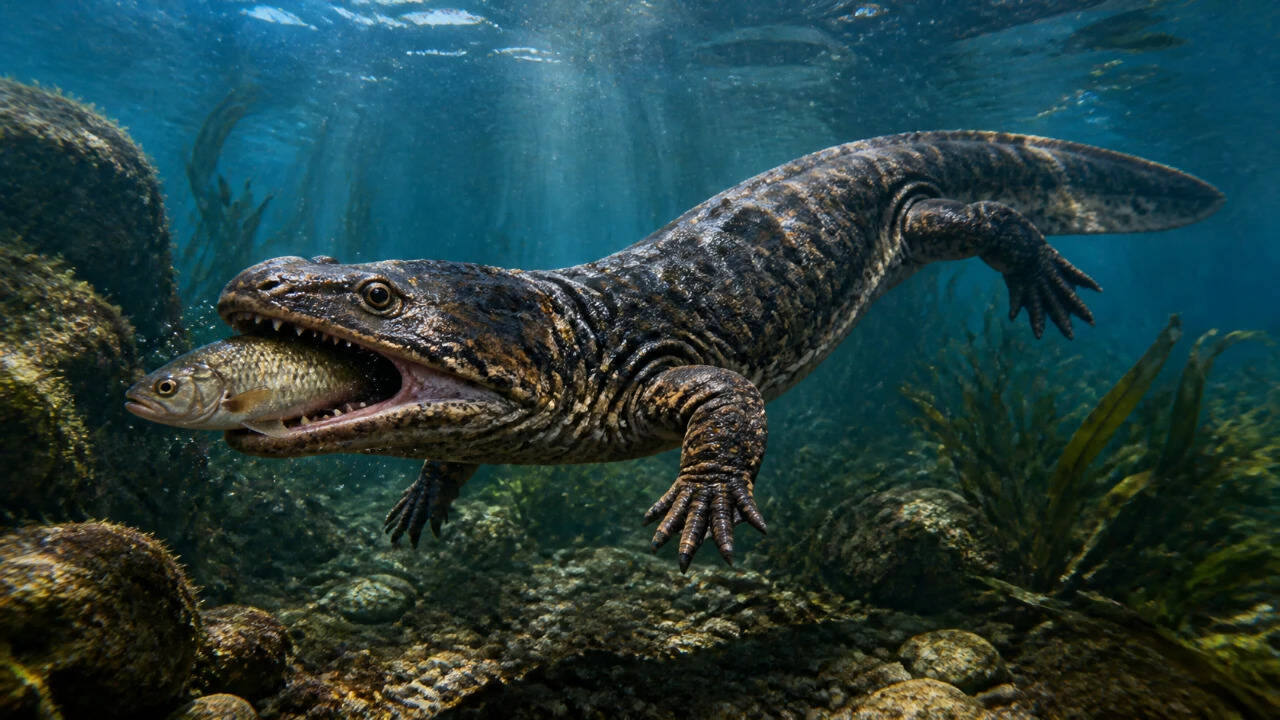
In 237 million-year-old fossil found in China, scientists have discovered evidence of an amphibian that may have lived entirely in the sea. The creature, named Gerrothorax maritimus, was about 2.4 feet long and existed during the Late Triassic period. Unlike modern amphibians, which can survive in both water and land, Gerrothorax maritimus had a flattened, disc-shaped body covered in bony armor.
This unique body structure may have helped the amphibian adapt to a marine environment by reducing water and salt loss through its skin, according to researchers from the University of Science and Technology of China. The discovery challenges the long-held belief that amphibians cannot live entirely in saltwater, as it suggests that the species may have evolved specific features to survive in such conditions.
The fossils were discovered in deep-sea sediments, hundreds of miles from landmasses during the Late Triassic period, indicating the amphibian lived close to the seabed. Researchers believe that Gerrothorax maritimus descended from a lineage of amphibians with extensive body armor that originally lived in freshwater environments.
Their findings, published in the journal Nature Ecology & Evolution, emphasize the need to reevaluate our understanding of amphibian evolution and the diversity of life in the ancient oceans.
Written by urgent.news from Times of India's reporting — not their text. Machine-written — may contain errors; check the original before relying on it.