What Makes A Bond Worth Buying? A Framework For Comparing India’s Top Corporate Bond Opportunities
In recent years, Indian fixed income markets have seen increased participation from different investor groups as access to corporate bonds has become more structured. Earlier, these instruments were primarily accessed through institutional channels, but digital systems have gradually introduced more structured and transparent access to bond information. This shift has also increased the need for…
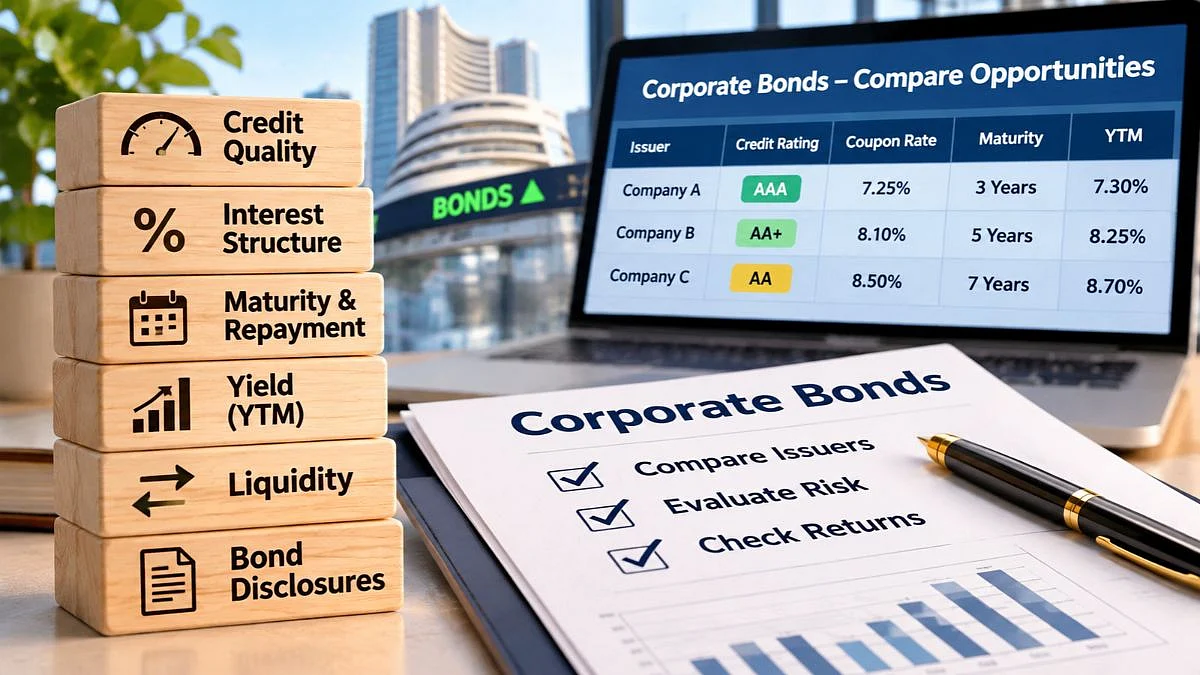
Corporate bonds have become increasingly accessible to various types of investors in India, thanks to improved digital infrastructure. This accessibility has led to a greater need for reliable methods of comparing different bond opportunities.
Investors do not rely on a single factor to determine if a corporate bond is suitable for their portfolio. Instead, they typically consider a combination of characteristics, including the bond's interest payment structure, the issuer's credit quality, the bond's maturity, and its potential role within a diversified investment portfolio.
The rise of digital investment platforms has greatly facilitated the comparison of corporate bonds. These platforms present key bond information, such as issuer details, credit ratings, coupon rates, maturities, and disclosures, in a structured format. This makes it simpler for investors to review and compare multiple bond opportunities within a single interface.
Corporate bonds often offer regular interest payments at predetermined intervals, known as coupons. The payment structure and the issuer's ability to meet these obligations are important considerations for investors evaluating fixed-income instruments. Bonds also generally have a specified maturity date, after which the principal amount is repaid. This defined repayment timeline can be useful for investors who are planning around specific financial horizons.
One of the key benefits of corporate bonds is their potential to add diversification to an investment portfolio. Unlike equities or fixed deposits, bonds have different structural characteristics that can provide additional diversification within an overall investment strategy.
The corporate bond market in India is regulated by the Securities and Exchange Board of India (SEBI), and issuances and settlements follow established regulatory frameworks. This regulatory environment ensures standardised disclosures, credit ratings, and offer documents, which are essential for comparing bonds across different issuers and issuances.
To compare bond opportunities effectively, investors can use a structured evaluation framework that reviews similar parameters across issuers. This includes comparing the issuer's credit profile, which involves evaluating credit ratings alongside the issuer's financial position, business performance, and repayment history. Investors also consider the coupon structure, as bonds with similar rates may differ based on whether interest is fixed or benchmark-linked, and the frequency of coupon payments.
Maturity and repayment structure are also crucial factors to compare. Bonds with similar maturities provide a more meaningful basis for evaluation. Additionally, investors should compare the yield alongside credit quality, as a higher yield may result from differences in credit profile, maturity, liquidity, or market conditions. Comparing yields among bonds with similar characteristics offers a clearer context for evaluation.
Liquidity is another important consideration, as it influences how easily a bond can be traded before maturity. Comparing trading activity and market availability among bonds with similar features can help differentiate them. Reviewing bond disclosures, such as offer documents, credit rating reports, and issuer disclosures, is essential for understanding the bond's terms and conditions.
These documents provide detailed information about the coupon structure, repayment provisions, and other important features that may impact the overall evaluation of the bond.
Digital platforms have played a significant role in making corporate bond information more accessible and comparable. These platforms present issuer details, credit ratings, coupon rates, yield-to-maturity (YTM), maturity dates, and disclosures in a structured format. This allows investors to review different corporate bond issuances through a single interface, making the comparison process more systematic.
In conclusion, comparing corporate bond opportunities requires a comprehensive evaluation of multiple characteristics rather than relying on a single measure, such as yield or credit rating. Crucial factors to consider include the issuer's credit profile, interest structure, maturity, liquidity, and bond disclosures. With the increasing digitalisation of the Indian fixed income market, platforms like Altifi provide standardised information on corporate bonds, facilitating the review and comparison of instruments within India's fixed-income market.
Written by urgent.news from Free Press Journal's reporting — not their text. Machine-written — may contain errors; check the original before relying on it.