Umstrittener Justizumbau: Heftiger Machtkampf um Polens Verfassungsgericht entbrannt
Polens rechtskonservativer Präsident und die Mitte-Links-Regierung streiten um die Besetzung des Verfassungsgerichts. Demonstranten belagern das Gerichtsgebäude. Und die Fronten verhärten sich weiter.
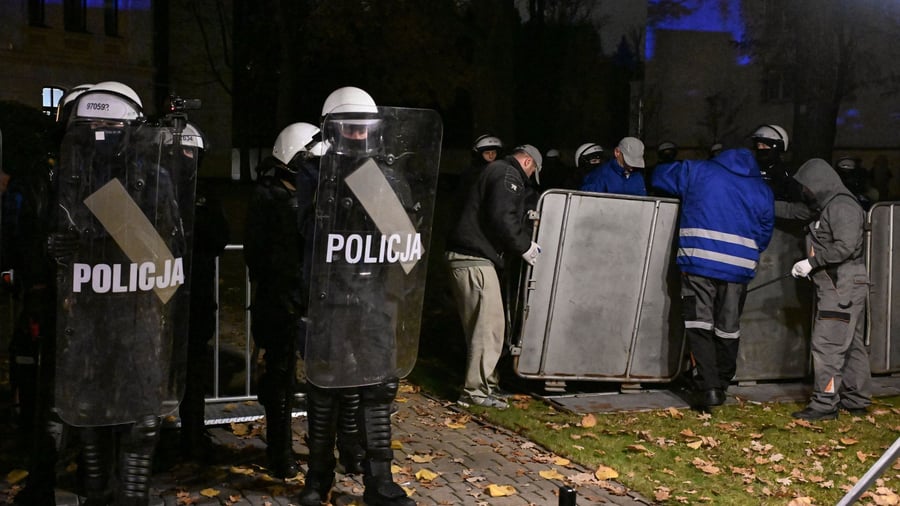
In Poland, a contentious restructuring of the judiciary has ignited a fierce power struggle between the center-left government and the right-conservative camp centered around President Karol Nawrocki and the Supreme Constitutional Court. Hundreds of demonstrators gathered outside the court's headquarters in Warsaw, accusing Prime Minister Donald Tusk and his government of undermining the country's constitution and justice system.
The police cordoned off the building, prompting Nawrocki to cancel his trip to Senegal and head to the Constitutional Court for further discussions. The crisis was triggered by a notice on the court's website announcing that the court president and his deputy had been stripped of their duties, with a newly appointed judge taking charge.
However, the root of the conflict lies deeper. The dispute pits Poland's pro-European, civic coalition led by Tusk and his allies against the right-conservative opposition PiS and its ally President Nawrocki. The PiS, which ruled the country from 2015 to 2023, packed the court with pro-PiS judges. The European Court of Human Rights had previously ruled that the Polish Constitutional Court could not be considered independent and impartial due to serious defects in the appointment of its judges and former president under the PiS.
In recent months, Tusk has sought to undo the PiS's contentious reforms in the judiciary. However, Nawrocki has resisted, refusing to swear in five judges nominated by the parliament. When these judges instead resigned before swearing in, the still-nominated court president Bogdan Swieczkowski denied them entry to the building. The demonstrators outside the court demand the invalidation of the previous court president's removal and demand Tusk's government reverse its actions.
Many of them also express deep distrust of Poland's ruling government, often following anti-German narratives of the PiS. The specifics of the power struggle surrounding the Constitutional Court seem less relevant to many protesters, who see it as a means to "defend the Fatherland" or prevent the Constitutional Court from being abolished.
The escalation appears to be driven by recent events, such as the announcement by judge Anna Korwin-Piotrowska that both the previous court president Swieczkowski and his deputy had been replaced, with she herself taking over the leadership. Swieczkowski refused to accept this, calling it a coup d'état. Korwin-Piotrowska, who was among the five constitutional judges Nawrocki refused to swear in, protested on TVP that Swieczkowski had rendered the court dysfunctional by denying the new judges entry.
As the former president's seniority, she called for a meeting of all constitutional judges on November 3rd. Tusk emphasized in a statement on X that his government's duty was to restore the rule of law in Poland. "After years of impunity under the PiS government, this is a difficult, sometimes painful process that requires decisive action.
There is no other way." The standoff between Nawrocki and Tusk has not only divided Poland's split society but also weakened the country politically. Poland has gained considerable political and military importance in the EU and NATO as an ally of Ukraine, but it cannot leverage this potential due to its inability to speak with one voice.
Critics accuse Nawrocki and the PiS of deliberately escalating the conflict and driving the country into a state of crisis, which benefits Tusk and his government in the upcoming parliamentary elections, as voters might blame the chaos surrounding the Constitutional Court and the resulting destabilization of state affairs on Tusk.
For the PiS, however, tightening their belts could result in gaining more support from the right-wing fringe, where Nawrocki is particularly popular. Unlike Tusk, he has much to lose and his term extends until 2030.
Written by urgent.news from Handelsblatt's reporting — not their text. Machine-written — may contain errors; check the original before relying on it.