Rooibos seeds set to journey into space as part of groundbreaking experiment
Rooibos sets out on a remarkable space mission, opening up new avenues for research and motivating South Africa's upcoming scientific generation.
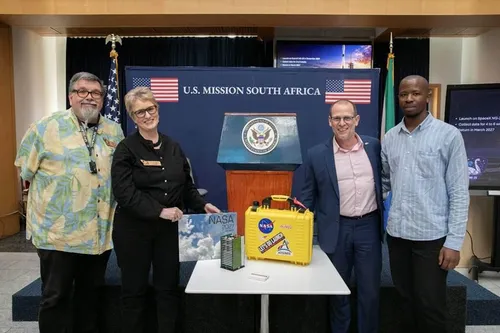
Rooibos in Space, an innovative South African project, is set to send seeds into orbit as part of a groundbreaking experiment. The United States Consul General in Cape Town, Allison Areias, recently hosted a farewell event for South African science experiments bound for the US, marking a significant step for the Rooibos in Space project.
A total of 17,346 Rooibos seeds, weighing 74.2 grams, will join these experiments on the same spacecraft destined for the International Space Station (ISS). These seeds are divided into three groups: untreated, scarified, and scarified and treated with a protective agricultural coating. The seeds will be placed inside a Nanolab, a compact research module designed for spaceflight experiments, to study their reaction to microgravity and space radiation.
The Nanolab will travel to the ISS aboard the Cygnus NG-25 commercial resupply spacecraft, with launch expected between December 2026 and January 2027. Once in space, the seeds will remain for four to six weeks before returning to Earth for analysis. Over the subsequent 18 months, schools in the Cederberg region, where Rooibos is native, and Parklands College will monitor, measure, and analyze the differences in germination, growth patterns, and plant development between space-exposed seeds and control seeds.
This project not only offers learners the chance to participate in a real scientific investigation but also allows them to develop practical STEM skills. Rooibos in Space, a collaborative effort between the South African Rooibos Council and MaxIQ Space, is the first time a South African indigenous plant seed will be sent into space for such research, providing unique insights into how Rooibos, an adapted plant to the Cederberg region, behaves under extreme space conditions.
Written by urgent.news from IOL's reporting — not their text. Machine-written — may contain errors; check the original before relying on it.