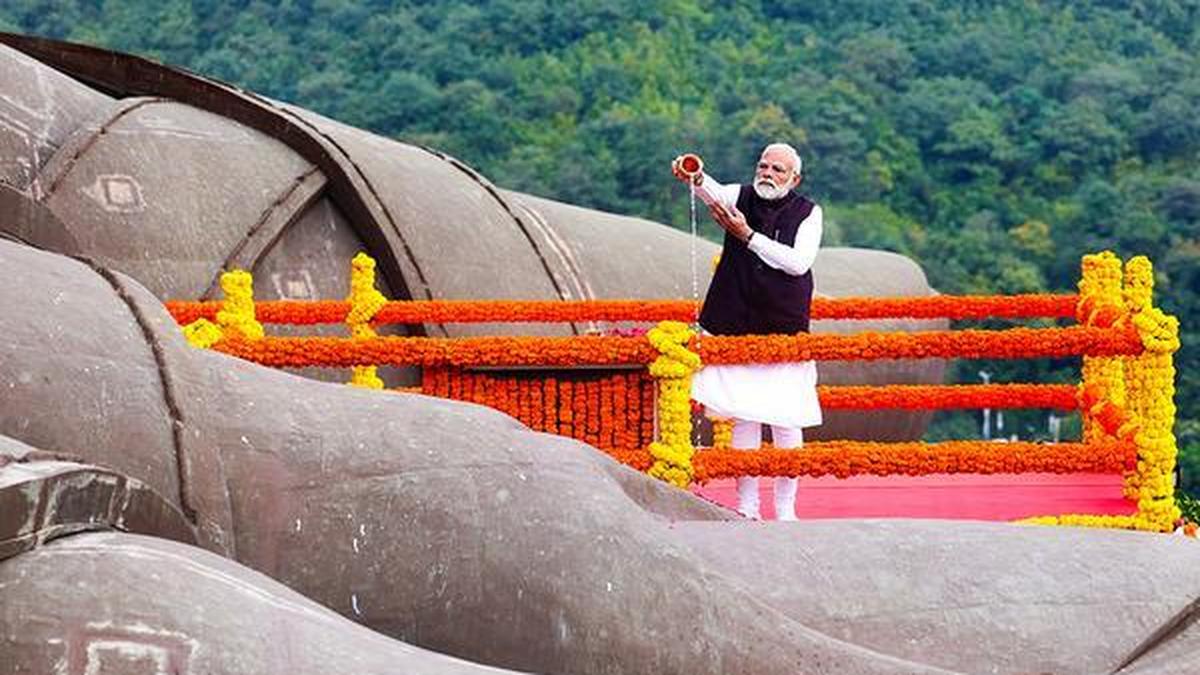
PM Modi offers floral tributes to Sardar Patel at Statue of Unity
October 31 is observed every year as National Unity Day to commemorate the birth anniversary of Sardar Patel, who played a pivotal role in integrating princely states into the Indian Union after Independence
On October 31, 1950, Sardar Vallabhbhai Patel delivered a one-and-a-half hour speech to over two lakh people at a gathering near Lal Darwaja in Ahmedabad on his 76th birthday. This assembly was his last in the city before his passing on December 15 of the same year. Patel had ceased his role as president of the Ahmedabad Municipal Corporation two decades earlier, but his impact on the city remained profound.
In 1959, President Rajendra Prasad unveiled a statue of Patel on the very site where he delivered that historic speech, later developing into the municipal garden named Sardar Baug. Currently, this redeveloped garden is managed by Union Minister Amit Shah. Patel's legacy continues to be celebrated on his 151st birth anniversary.
Born in England after studying law there, Patel returned to his hometown of Bombay (now Mumbai) in 1913 where he opened a practice as a criminal lawyer. However, he preferred residing in Ahmedabad, stating that serving the city brought him mental peace. Patel's tenure as a councillor and president of the Ahmedabad Municipality from 1917 to 1928 marked transformative changes. He believed in strong local governance and civic responsibility, which fundamentally shaped the modern city of Ahmedabad.
Patel's contributions to Ahmedabad were extensive. He expanded the city beyond its original fort boundaries, implementing town planning schemes which included new roads, drainage systems, libraries, schools, hospitals, and other public amenities. He championed the cause of quality education, ensuring qualified teachers were appointed to provide education to Muslim students, and introduced free primary education.
Patel also inspired the formation of co-operative societies, such as the Brahmakshatriya Co-Op Housing Society in 1924, and facilitated the organization of milk producers in Kheda district into a cooperative known as "Amul".
During the plague outbreak in 1917, Patel, serving as chairman of the health and sanitation committee, led a massive cleanup campaign across the city, demonstrating his commitment to public health. His efforts in flood relief following heavy rains were equally commendable, with Patel organizing volunteers to reach affected areas, showcasing his visionary leadership even before earning the title "Sardar".
Patel's influence extended beyond local governance; his involvement in relief operations and civic projects reflected his dedication to the welfare of the people of Ahmedabad. His work in town planning, education, co-operation, and relief operations earned him the title "Sardar" for his leadership qualities and dedication to the city's growth and development.
Written by urgent.news from The Indian Express's reporting — not their text. Machine-written — may contain errors; check the original before relying on it.
This story
This is one outlet's version. Read the fullest account.
- How Sardar Vallabhbhai Patel helped build modern Ahmedabad indianexpress.com