India’s first fusion power company takes key steps
Designs for the first privately built tokamak, a nuclear reactor that uses fusion to produce energy, could be firmed up in 2027 by Bengaluru-based startup Pranos Fusion
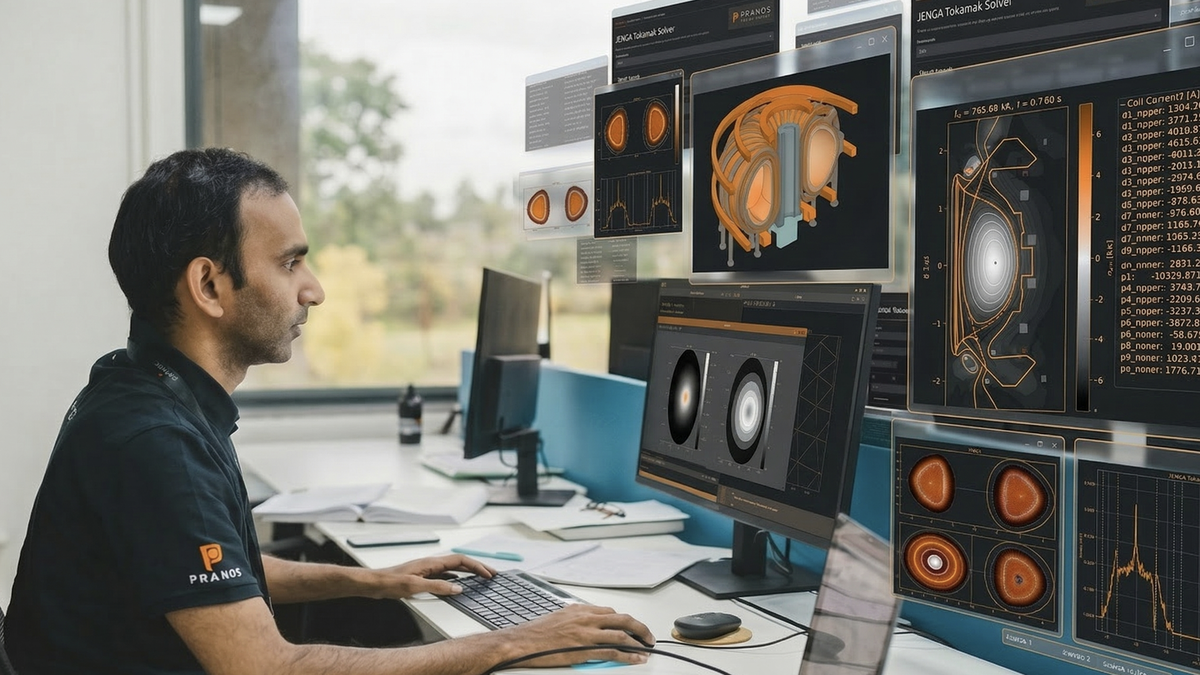
India's first fusion power company, Pranos Fusion, is making significant strides towards constructing the nation's first privately built tokamak, a nuclear reactor that harnesses fusion to generate energy. The company's small, doughnut-shaped tokamak, named PRAGYA, is being utilized to test plasma control and superconducting magnets.
In the future, Pranos Fusion aims to finalize the blueprint for a much larger tokamak, PRANIK, by 2027. This reactor will heat plasma to millions of degrees, necessary to fuse hydrogen atoms and produce energy. Shaurya Kaushal, co-founder and CEO of Pranos Fusion, stated that the company anticipates building a practical reactor that can generate electricity in a subsequent step after finalizing the PRANIK design.
Pranos Fusion operates under the umbrella of the Institute of Plasma Research, affiliated with the Department of Atomic Energy and the Jawaharlal Nehru Centre for Advanced Scientific Research in Bengaluru. Fusion power involves merging light atomic nuclei, predominantly hydrogen isotopes deuterium and tritium, into helium and a high-energy neutron.
This process requires plasma to reach temperatures around 100 million degrees Celsius, far hotter than any solid wall could withstand. To prevent this superheated plasma from touching the walls and losing heat, tokamaks employ powerful magnets to contain it.
While fusion power's initial costs are high and electricity generation remains a future prospect, its potential as a sustainable energy source is increasingly recognized. Roshan George, a co-founder of Pranos Fusion and a computer science engineer from Manipal Institute of Technology, highlighted that fusion's advantage lies in its reliance on deuterium, a readily available resource India already produces in abundance.
Moreover, fusion reactions do not pose the same risk of a runaway chain reaction as fission reactors. The International Thermonuclear Experimental Reactor (ITER), a large-scale tokamak under construction in France, is a collective effort by several nations, including India. However, ITER's timeline has been delayed, with research operations set to begin in 2034 and deuterium-tritium operation scheduled for 2039, significantly increasing its cost.
The size and scale of a tokamak directly impact its development costs. A compact research machine like PRAGYA represents a comparatively modest investment, whereas a tokamak designed to achieve net energy gain is significantly more expensive. Backed by investors such as Ankur Capital, pi Ventures, and Industrial47, Pranos Fusion has raised $7.2 million to date.
The company's strategies include leveraging high-temperature superconducting (HTS) magnets, which carry electric current without resistance when cooled below a critical temperature, to reduce costs. HTS electromagnets have achieved field strengths of around 20 tesla in tests, making smaller, more powerful machines feasible.
Written by urgent.news from The Hindu - Sci-Tech's reporting — not their text. Machine-written — may contain errors; check the original before relying on it.