Bolt Graphics powers on its first Zeus GPU
Bolt Graphics has been working on its simulation-centric Zeus GPU for a while now and has reached a significant milestone: a successful test run.
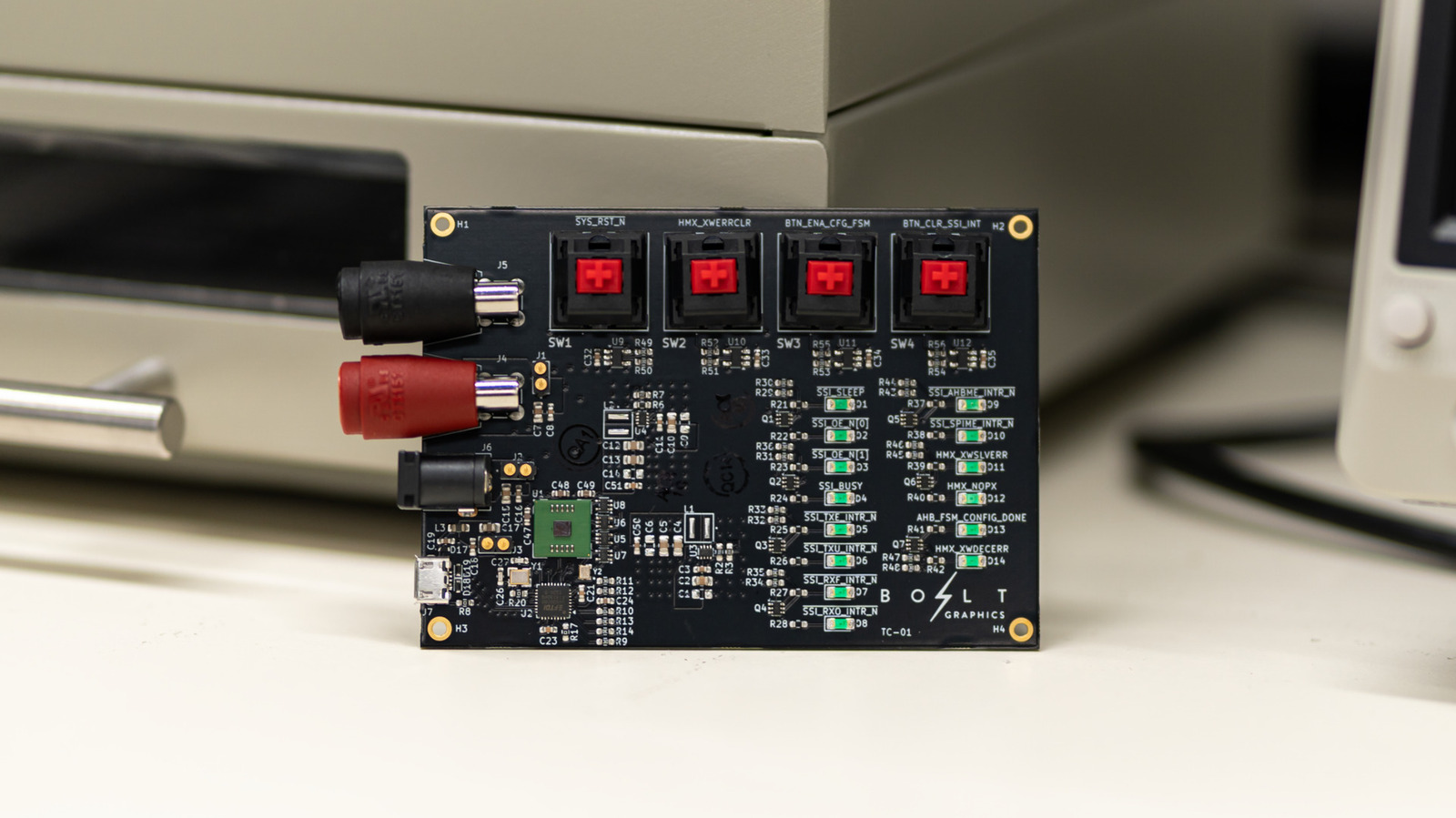
Bolt Graphics marked a milestone in its Zeus GPU project by powering on its first test chip, marking progress but with the card still far from mass production. The California-based startup revealed that the 12nm test chip, manufactured by TSMC, ran smoothly when powered on without any issues. In addition, Bolt opened an office in Taipei to maintain proximity to its manufacturing partners as production neared.
Reuters later reported that Bolt was seeking around $100 million in funding at an estimated value of $700 million, according to sources familiar with the situation.
The tiny 6mm^2 test chip consumes 1.4 watts, significantly lower than the 35-watt FPGA (reprogrammable chip) previously used by Bolt for design purposes. The chip's standout feature is its dedicated hardware for electromagnetic simulation, a capability that enables the design of various components, including radar sensors and camera lenses. Bolt's CEO and founder, Darwesh Singh, expressed pride in the chip's ability to run a highly intricate physics algorithm, accelerated in hardware—a first for others.
However, Bolt has not disclosed any performance metrics for the test chip, only affirming that it outperformed the company's internal expectations. The anticipated Zeus GPU, which Bolt plans to unveil, will utilize TSMC's N5P process node. This decision was made to circumvent competition for limited wafer supplies from other chipmakers. The Zeus GPU is powered by RISC-V processor cores, an open-standard instruction set, combined with Bolt's own path-tracing hardware.
The PCIe cards for the Zeus GPU will incorporate soldered LPDDR5X memory and DDR5 SO-DIMM slots, akin to those commonly found in laptops, allowing users to expand the memory up to 384GB. When initially announced in March 2025, Bolt made bold assertions, claiming that Zeus could deliver 10 times the rendering performance of existing GPUs and 300 times the speed in electromagnetic simulation, with the potential to generate up to 10 times the path tracing throughput of Nvidia's RTX 5090. These claims, however, have yet to be independently validated.
Bolt's primary target audience for Zeus comprises studios, engineers, and scientists, with plans to eventually enter the gaming and AI sectors. This move would place the Zeus GPU in direct competition with Nvidia and AMD in the consumer GPU market. Given the extensive software support required for gaming chips to accommodate thousands of existing games, this venture presents an intriguing challenge.
By April 2025, Bolt reported that over 14,000 businesses, developers, and individual users had signed up for its early access program, and the company's product pipeline was valued at more than $500 million. However, the startup refrained from disclosing specific customer information. In the same announcement, Bolt claimed that Zeus could reduce compute costs by up to 17 times compared to current hardware.
Written by urgent.news from Engadget's reporting — not their text. Machine-written — may contain errors; check the original before relying on it.