Zukunftsgestalter: Trumpf auf dem Weg zum Maschinen-Menschen
Für Trumpf reicht es nicht mehr, nur die besten Laser zu bauen. Was im Kampf gegen chinesische Konkurrenten zählt, sind Gesamtsysteme mit Robotik. Trumpf erobert das neue Feld mit KI.
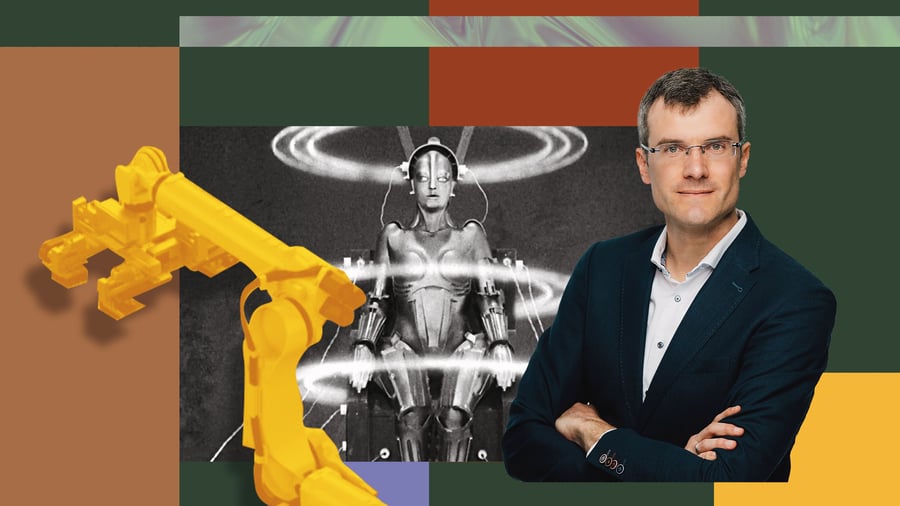
In the development hall of Trumpf in Ditzingen, a revolution in robotics is beginning, not with a spectacular-looking robot, but with the moment when machines stop receiving predetermined movements and start deciding for themselves. However, robotics is not a core theme of the family-owned company, which specializes in laser applications, from sheet metal processing to chip production.
Yet, the DNA of the company lies in always staying on top of the latest technologies and maintaining close contact with research and science. The secret to Trumpf's success is making industrial robots more intelligent, as they are intended to complement sheet metal machines and create competitive advantages. Chinese competitors are already challenging Trumpf's position as the world leader in this field. The Handelsblatt has obtained exclusive insights into the sensitive area of Trumpf's research.
Ralph Lange, the Robotics Chief of the Mittelstand company, emphasizes that a robot does not need to look like a human in the factory. It only needs one arm or three, and it may not need a head at all. The intelligence can reside either within the robot or in the cloud. Trumpf primarily focuses on making robots smarter, especially through software.
The company employs around 600 developers for its own software and has a KI (Artificial Intelligence) team with 12 people in the headquarters and 90 others worldwide. Sarah Engel, Head of AI at Trumpf, states that "Artificial Intelligence is no spectator sport. We involve all employees. We have a mandatory training, but we rely on curiosity and demonstrate applications on-site."
The Trumpf approach: The road to enlightenment curiosity and self-development have always been two important driving forces in the Trumpf cosmos. Berthold Leibinger, the company's founder, laid the groundwork for his first invention during his diploma thesis in 1957. The copying and nibbling machine allowed for the quick and precise copying of contours and samples from metal parts based on a template, earning Leibinger the nickname "Nibbler King" upon his death in 2018.
He paid for his patents with shares in the company, which eventually became the sole property of Nicola Leibinger-Kammüller, his granddaughter, who inherited it from her father, Christian Trumpf, who founded the company in 1923. In the 1970s, Leibinger recognized the potential of lasers for sheet metal processing and refined the technology to make it suitable for mass production.
Today, Trumpf, led by Nicola Leibinger-Kammüller, is the world leader in industrial lasers. Their applications extend far beyond sheet metal cutting, ranging from smartphone screen processing to ultrashort-pulse lasers and EUV lasers and plasma generators, all of which are essential for producing the latest and most powerful chips.
No other company can match this capability. With semiconducting technology alone, Trumpf has created a completely new branch, generating a billion euros in revenue within 20 years. However, not everything Trumpf undertakes succeeds. Some ventures into new technologies have been abandoned, including 3D metal printers and photonics sensors acquired from Philips a few years ago.
For the Trumpf leadership, such failures are part of the process: "We will always adapt to new techniques and opportunities in the world, even if we don't jump into them." The company consistently integrates new technologies into its products to move forward. KI (Artificial Intelligence) and its application in robotics are part of this picture.
Customer replacement part orders at Trumpf are already largely handled by KI. However, AI still faces limitations. "When it comes to risks, direct exchange between the customer and the service specialist is safer, as AI sometimes assumes when it doesn't know something and starts to speculate," says Tool Machine Chief Stephan Mayer, adding "and more" to emphasize the ongoing progress.
AI agents within the company already complement and control each other in processes and software development, which becomes faster through AI. Today, algorithms independently analyze motor currents of an axis with 52 parameters, compare them with end-use values, and remotely diagnose the condition of an axis. Currently, there are over 50,000 Trumpf tool machines, with one-fifth connected online in real-time.
At new machines, the online percentage is 70. KI is also intended to enhance laser-controlled processes.
Written by urgent.news from Handelsblatt's reporting — not their text. Machine-written — may contain errors; check the original before relying on it.
This story
This is one outlet's version. Read the fullest account.
- Shapers of the Future: Trumpf on the Way to the Machine Human handelsblatt.com