Europe’s trade pivot towards diversification, growth: QNB
Over the past two years, the external environment of the EU has deteriorated markedly, as its two largest trading partners have become less reliable at the same time, QNB stated in its latest economic...
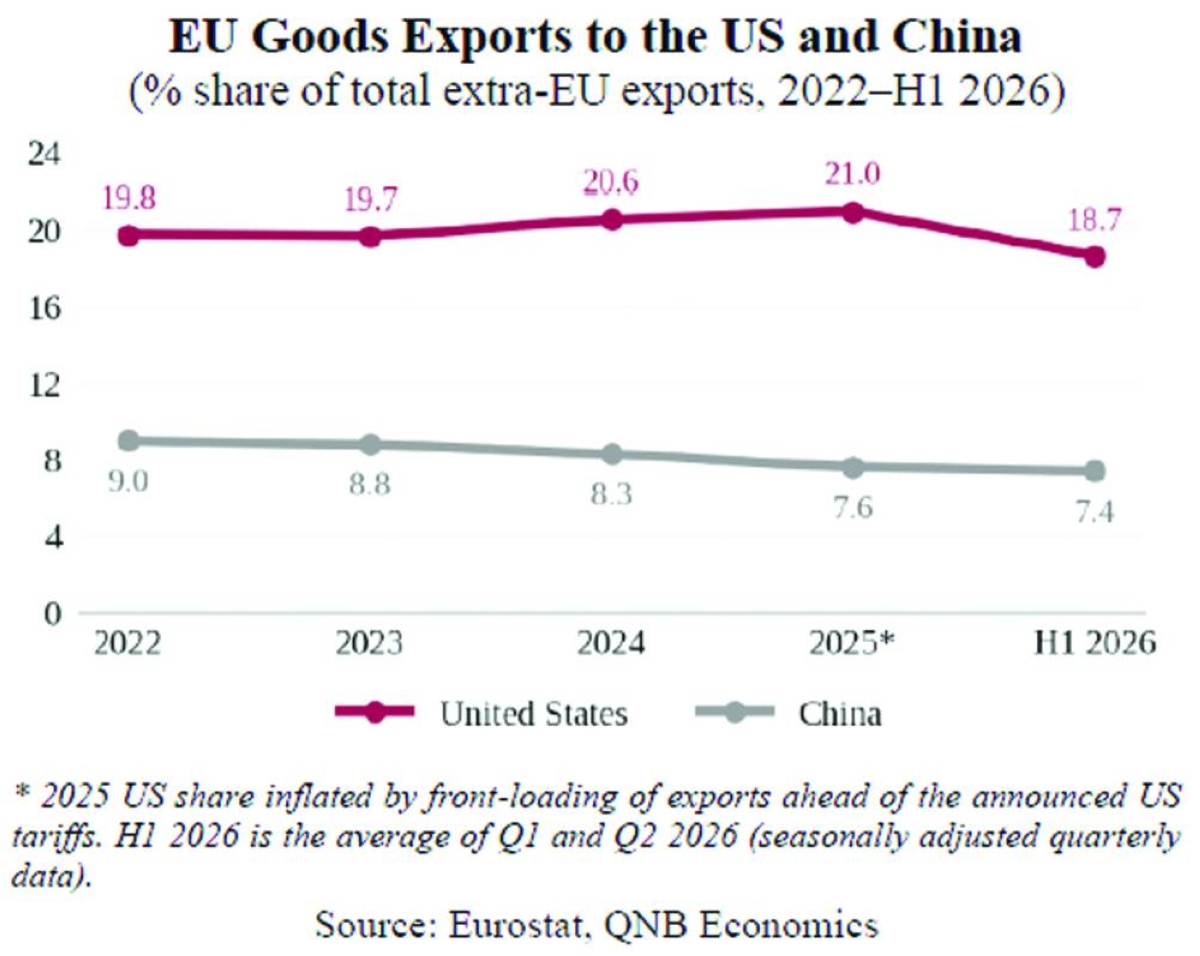
Over the past two years, the European Union's external trading environment has significantly worsened due to unreliable relations with its two largest trading partners, according to QNB's latest economic commentary. The United States implemented a new EU-US Framework on Reciprocal, Fair, and Balanced Trade, which entered into force on July 1, 2026, establishing a 15% tariff ceiling on most EU exports, posing a substantial barrier for Europe's largest export market.
In contrast, China, previously a crucial demand source, has transformed into a growing competitor, with the EU's goods trade deficit with China reaching €359.8bn in 2025. This was due to a 6.5% decline in EU exports and a 6.4% increase in imports. In response, Brussels has embarked on its most extensive expansion of its trade network in decades.
In 2025 and the first half of 2026, the EU signed trade agreements with Mercosur, Mexico, Indonesia, India, and Australia, which will increase the share of the EU's external trade covered by free trade agreements to 53.3%, up from 46.3% at the end of 2025. QNB predicts that this pivot is now extending into Southeast Asia, as agreements with the Philippines, Thailand, and Malaysia are in progress, with all three expected to be completed by 2027, resulting in a near region-wide network across ASEAN.
The EU's trade pivot is a strategic response to a lasting shift in the global trading environment, aiming for three key objectives: diversifying away from main trading partners, securing new sources of external demand, and fostering growth opportunities for a struggling European economy, as well as enhancing economic security through more dependable access to essential raw materials.
Three key benefits stand out from this trade pivot: reducing exposure to increasingly unpredictable main trading partners, opening up new sources of external demand, and providing economic security through more reliable access to critical raw materials. The EU's reduced dependence on its two largest trading partners, US tariffs impacting demand, and China redirecting lost US exports towards Europe, are contributing to the diversification of external demand.
Written by urgent.news from Gulf Times Business's reporting — not their text. Machine-written — may contain errors; check the original before relying on it.