Doch eine Art «assoziiertes Mitglied»: Der Gipfel EU-Kanada endet mit einer Überraschung
Die EU hat sich lange gestritten, wie ihr Verhältnis zu Kanada aussehen solle. Kommissionspräsidentin Ursula von der Leyen hat sich mit ihrer Vision durchgesetzt. Das könnte gerade auch die Schweiz und die EWR-Länder befremden.
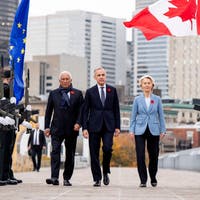
Die EU and Canada concluded an unexpected summit in Montreal on Thursday and Friday. Commission President Ursula von der Leyen had insisted on her vision that Canada should become the "first associate EU member." However, her statement met opposition from some EU countries. Canadian Prime Minister Mark Carney seemed to go too far with this vision.
Surprisingly, both Carney and von der Leyen used the term "associate EU member" at the end of the summit. Von der Leyen argued that Canada and the EU shared a connection similar to "ever-closer association short of full membership." This meant that in the future, Canadian students would study in Europe under the "Erasmus" program, and Canadian scholars would participate in the Horizon research program.
The European Investment Bank, EIB, would finance resource projects in Canada to make Europe less dependent on China. Canada would also join European satellite programs Galileo and Iris2. The most concrete promise was Carney's commitment to Ukraine: Canada would contribute 500 million euros to the 90-billion-euro loan the EU granted to war-torn Ukraine for weapons purchases and administrative expenses.
The term "associate membership" might still be debated, not only in Brussels. It could cause surprise among EFTA countries Norway, Iceland, and Liechtenstein, as well as Switzerland, which is closely linked to the EU through bilateral treaties. They see themselves as the EU's closest partners, relying on detailed agreements while "associate membership" does not exist in the EU.
Von der Leyen's insistence on this concept could be due to the belief that setting ambitious, if unrealistic, goals drives progress. However, there's a less charitable view that she's again been carried away by her penchant for visionary announcements, leaving member states scrambling to catch up. Germany and Chancellor Friedrich Merz were particularly unhappy with von der Leyen's overreach.
The status she wants for Canada and possibly other non-European states may be more appropriate for Ukraine's bid to join the EU. Given Ukraine's current state, joining the EU seems unlikely. A phased accession, such as an associate membership status, might be a more viable alternative. Considering Canada's cultural and economic ties with the US, it's nearly as close as Switzerland's relationship with southern German states.
The US's impact on Canada is significant, with two-thirds of Canadians living within 100 kilometers of the American border, and nearly two-thirds of Canadian exports going to the US. However, both countries face a major dependency on the US, which has become an unpredictable partner under President Trump. While both the EU and Canada want to diversify economically, a more nuanced approach might be more appropriate.
They could simply have called for "deepening discussions in selected economic and political fields" at the summit, even though the goal seemed to be more dramatic. Von der Leyen declared it a "historic day." The exact implications of associate membership will be clarified at a summit a year from now. The story of associate membership is not new, especially not in Brussels.
Written by urgent.news from NZZ Wirtschaft's reporting — not their text. Machine-written — may contain errors; check the original before relying on it.