Australian PM to visit Beijing after China-hosted Apec summit as tensions simmer
Australian Prime Minister Anthony Albanese is expected to travel to Beijing next month as Canberra seeks to deepen a relationship which stabilised after years of trade disputes but has been recently complicated by geopolitical tensions. Sources told the South China Morning Post that Albanese would first attend the Asia-Pacific Economic Cooperation (Apec) leaders’ summit in Shenzhen, which runs…
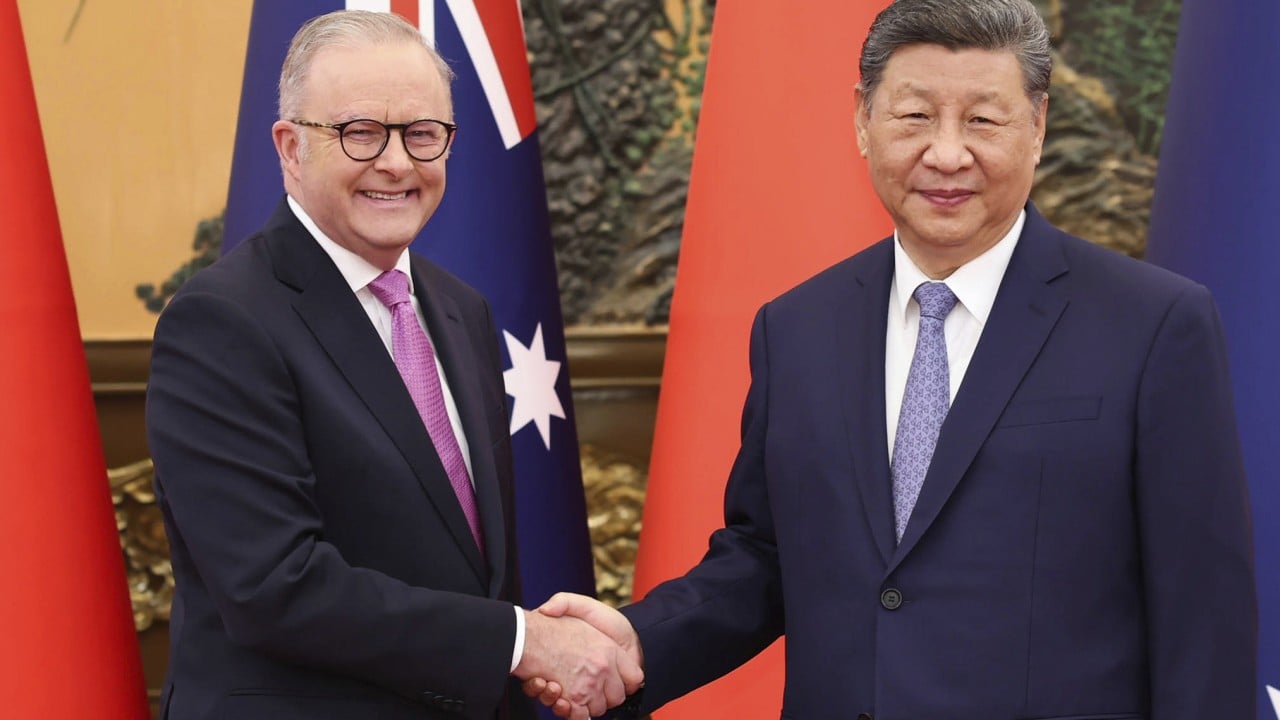
Australian Prime Minister Anthony Albanese is set to journey to Beijing next month, as Canberra strives to fortify the relationship that stabilized after years of trade disputes but has recently been strained by geopolitical tensions. Sources have indicated that Albanese will first participate in the Asia-Pacific Economic Cooperation (Apec) summit in Shenzhen, slated for November 18-19, before heading to the Chinese capital.
This will mark Albanese's third visit to Beijing since assuming office in 2022, and his first since July of last year.
Australia's rapport with China has been tested by a myriad of issues over the years, including the ban of Huawei Technologies from the nation's 5G networks and the enactment of a foreign interference law aimed at countering Beijing's influence in domestic matters. Relations deteriorated in 2020 following Australia's call for an international inquiry into the origins of Covid-19, prompting China to impose restrictions on key Australian exports such as coal, barley, and wine – measures widely perceived as retaliatory.
Following the ascension of the Albanese government in 2022, efforts were made to mend ties with Beijing, resuming high-level dialogue that had been dormant for years. Albanese's meeting with President Xi Jinping at the G20 summit in Bali in November 2022 was the first such encounter between the two leaders since 2016.
Albanese's inaugural visit to Beijing as prime minister occurred in 2023, and he has progressively witnessed a partial lifting of trade restrictions by Beijing, with the final measures removed by late 2024. However, tensions have persisted, with both parties exchanging accusations of close and dangerous military plane encounters in the South China Sea, and Beijing expanding its naval operations near Australian waters.
Australian Defence Minister Richard Marles attributed China's military build-up to creating a "condition of pressure" in Southeast Asia, urging regional allies to enhance cooperation to counter the challenges.
Albanese's latest encounter with Xi and other high-ranking Chinese officials took place in July 2025. The prime minister's office emphasized that nurturing the Australia-China relationship is crucial for Australia's future prosperity and security, stating that their approach remains patient, calibrated, and deliberate, with dialogue being the cornerstone of a stable and constructive relationship.
Xi acknowledged at the time that relations had "emerged from a low point and regained positive momentum," calling for mutual trust and deeper cooperation between the two nations. Liu Jinsong, China's ambassador to Australia, urged for stronger business ties between the countries, calling the economic and trade cooperation the "ballast" of the relationship.
He noted that the stabilization and recovery of Australia-China relations is "hard-won" and that the "great ship of China-Australia relations must brave the wind and waves, and the ballast must be made more solid and ever more stable."
Written by urgent.news from Reuters Business via SCMP's reporting — not their text. Machine-written — may contain errors; check the original before relying on it.
This story
This is one outlet's version. Read the fullest account.