Rent the model. Own the harness. Own the network.
Every AI stack has choke points. Most are traps.
In 2004, Tiger Woods was the world's greatest golfer, having won eight majors and been world number one for several years. He decided to change his swing and, with the help of Hank Haney, he started over from scratch. His driving accuracy dropped, and the media criticized his performance. Three years later, he had his best season ever.
This story is a metaphor for the dilemma many companies face today. They are running successfully, with fine numbers, yet someone on the team is making small changes with language models, calling it AI adoption. The easy option is to stick with it and renew the SaaS contracts for another year. However, that would be a significant risk for the company's future.
To become AI-first, companies need to adopt a more radical approach, similar to Tiger Woods' rebuild. This involves creating thirty or fifty specialized models and orchestrating them into a recursive organization that becomes smarter every quarter. Simply adding an AI wrapper on top of existing products is not enough, as this is akin to shuffling deck chairs on the Titanic, a concept explored in Infinite Leverage.
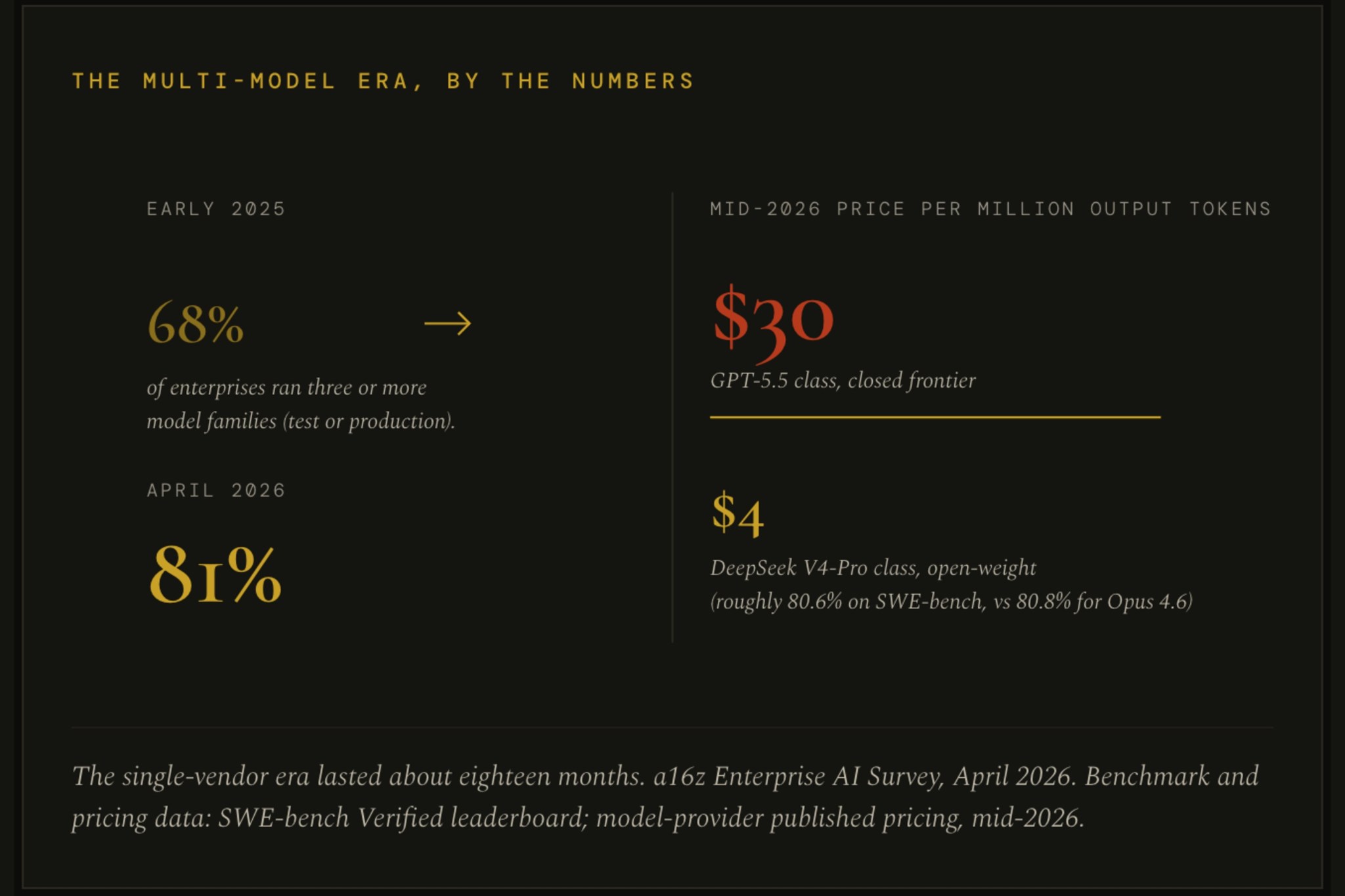
Language models are a good starting point, but they should not be seen as the ultimate solution. The frontier labs are pricing themselves out of their own market, and the capability gap between the best closed models and the best open ones is closing rapidly while the price gap remains vast. As a result, a commodity priced like a luxury will not remain a luxury for long.
Frontier labs recognize this issue, and they are responding by holding customers in place through inertia. This strategy mirrors the software industry's response to eroding moats. Companies find themselves trapped by choke points, which are any places in their architecture where a single party decides what they pay, what they can use, and how fast they can move.
Some choke points are beneficial, such as the one created by LinkShare in affiliate marketing. They dominated the market, providing a single set of reports, one check at the end of the month instead of chasing fifty small payments, and eliminating fragmented programs that could not compete. Affiliates and merchants remained loyal because the network and their interests aligned.
The best businesses are built around networks that benefit all parties involved. Google search improves as more people use it, Waze becomes more accurate with every driver, and eBay is worth more to sellers and buyers alike due to their interconnectedness. PayPal's security improved as more connections were made, and Collective[i] becomes smarter about economic behavior with each new company joining.
The real danger lies in the second-order effects of today's decisions. Leaders often overlook the implications of being AI-first. AI labs are trying to capitalize on this trend, learning from software companies as they did with SQL and PL/SQL. By bundling logic into the database, they run it faster and perform tasks that plain SQL cannot. However, this creates a choke point, making it difficult to leave the vendor due to the cost of rewriting decades of code.
In the AI world, lock-in occurs much faster than in software. Executives have less time to spot the trap and plan a rebuild. AI shifts the mood quickly, as seen when executives moved from ChatGPT to Claude following a Department of War contract decision. Open-weight models followed shortly after, forcing companies to lock into a single language-model vendor, thereby locking them out of the majority of the most important models they will deploy.
This is not a cost problem but an existential architecture mistake. Companies that do not recognize and address this issue risk spending the entire next cycle paying for a mistake that was avoidable. At Collective[i], this cycle is experienced weekly, and it is crucial for leaders to start using the term "choke points" to better understand and address the challenges they face in adopting AI.
Written by urgent.news from Fortune's reporting — not their text. Machine-written — may contain errors; check the original before relying on it.