'Real questions to be asked' after deadly train collision in Spain, journalist says
In this edition of Perspective, we focus on the tragic train collision that killed at least 68 people in Spain on Wednesday. We're joined by Nicholas Kingsley, executive editor of Railway Gazette International.
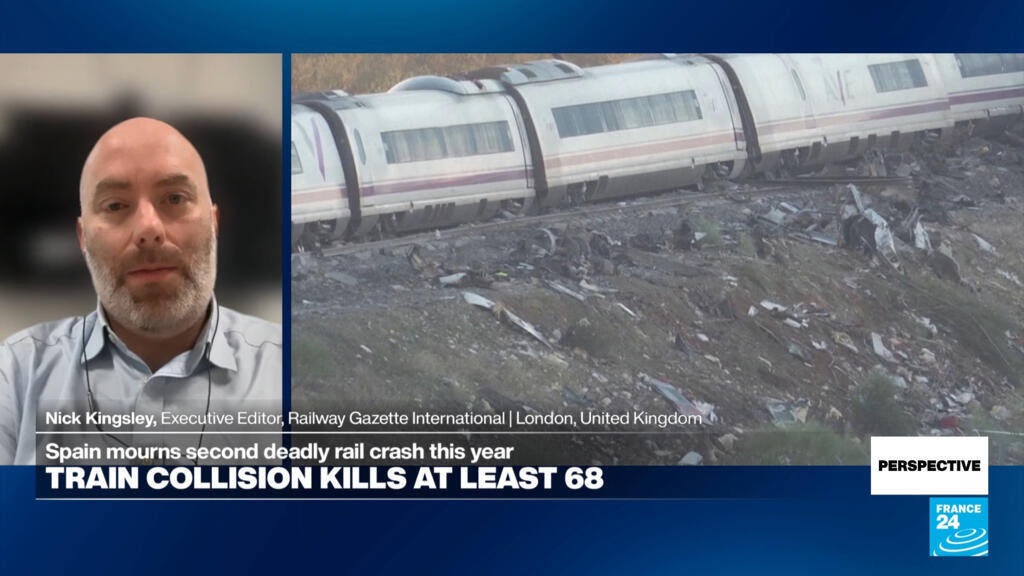
A high-speed train collision south of Madrid on Wednesday claimed 31 lives and injured 80 others, with the death toll expected to rise further. The region of Castilla-La Mancha, where the tragedy occurred, reported that one train became entangled with another, causing several carriages to flip over onto their sides at the bottom of a hill.
Emergency services and helicopters scrambled to the site as a frantic search for survivors unfolded. The Castilla-La Mancha government confirmed at least 31 fatalities and 80 injuries, stating that more victims are likely as "it has not yet been possible to reach the bottom of the carriages." The main high-speed railway line linking Madrid to southern Spain was suspended following the incident, which occurred when a Renfe train collided with a train operated by the private company Iryo.
The accident took place just before 9:00 am (0800 GMT) near the town of Urda, approximately 130 kilometers south of the capital. As the Socialist Prime Minister Pedro Sanchez faces unfavorable polls and considers running for re-election on November 29, his administration expressed shock and solidarity with the victims and their families, canceling his participation in a summit on obesity and halting all campaign activities in response to the disaster.
Condolences poured in from across Spain and Europe, with the Spanish royal household expressing shock and concern, and the European Commission pledging its readiness to assist Spain if required. European Commission President Ursula von der Leyen mourned the "devastating news," stating that Europe grieves alongside the victims. Spain's high-speed rail network, the second-largest in the world after China, has undergone significant investment but has faced increasing concerns about safety, following a deadly accident in January that left 46 dead.
This is the second major train disaster in Spain this year, with the first occurring on January 30 outside the village of Adamuz, resulting in 46 fatalities. The accidents both occurred on the Madrid-Seville high-speed line, which opened in 1992 to mark the Seville World Exposition.
Written by urgent.news from The Citizen's reporting — not their text. Machine-written — may contain errors; check the original before relying on it.
This story
This is one outlet's version. Read the fullest account.
- Spain high-speed train collision kills 31, injures 80 citizen.co.za
- Spain begins three days of mourning after train crash kills 69 france24.com
- Spain mourns after latest train tragedy kills 69 punchng.com
- Spain: High-speed train crash kills dozens, rescue operations ongoing dw.com
- What we know about Spain's deadly train crash that claimed 69 lives iol.co.za
- Deadly Spain high-speed train crash occurred after "inexplicable" controller decision, official says cbsnews.com
- Spain train crash: Aerial footage shows derailed coaches after collision kills 64 hindustantimes.com
- High-speed train crash in Spain leaves at least 64 dead torontosun.com