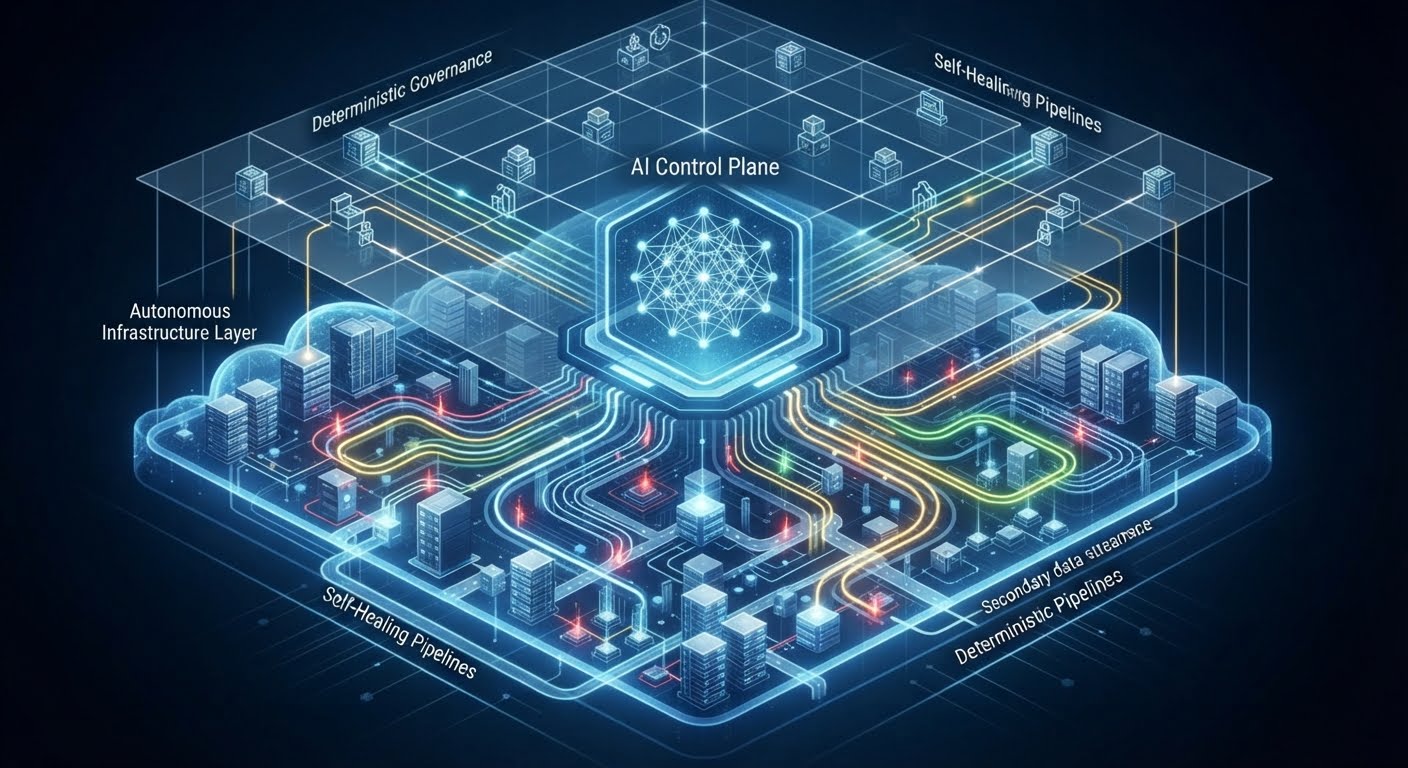
Modern Cooperative Autonomous Driving Ecosystem
Why autonomous vehicles need cooperative perception: a cross-ecosystem framework for sharing observations while preserving local autonomy, trust and privacy.
The Problem of Individual Autonomy
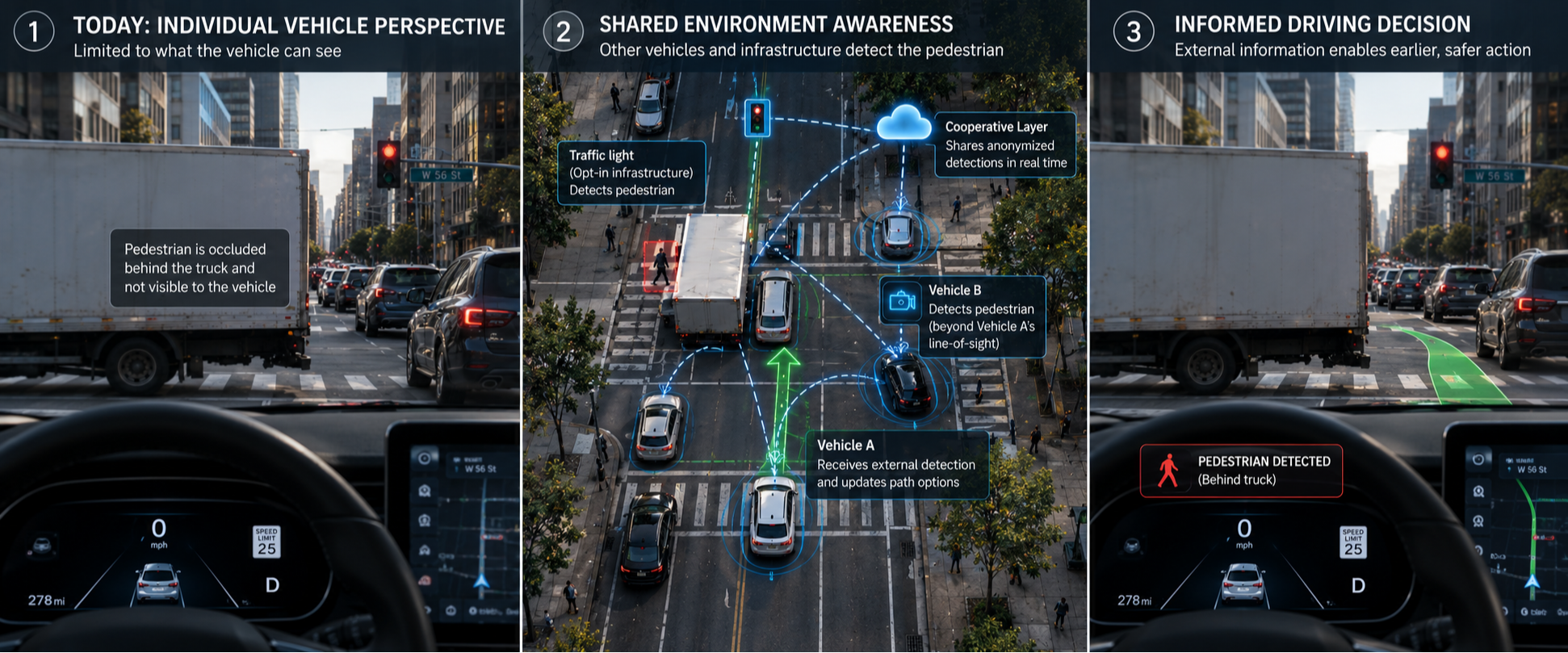
Modern autonomous vehicles are built upon a single architectural model: each vehicle constructs its own understanding of the shared environment. Cameras, radar, lidar, GPS, maps, and neural networks provide the raw data, which is then processed through perception, prediction, planning, and control systems to generate driving decisions.
This model treats autonomous driving as a series of individual intelligences working in parallel, each reconstructing the world from its own limited perspective. However, roads and infrastructure are inherently shared spaces where the actions of one participant directly impact others. Attempting to solve this shared problem through thousands or millions of independent systems is fundamentally flawed. Existing Sensors and Systems
While autonomous vehicles are equipped with a variety of sensors like cameras, radar, lidar, ultrasonic detectors, GPS, and mapping technologies, these individual systems still operate primarily in isolation. The data from each sensor is fed into the vehicle's perception system, which attempts to identify and classify objects in the environment.
However, without a mechanism for vehicles to share this information with one another, each autonomous system must independently reconstruct the same physical reality. The limitation is not in the sensors or the computational power of the vehicles, but in the way these systems are currently designed to operate. The Lack of Collective Perception
Despite years of research into vehicle-to-vehicle (V2V) and vehicle-to-infrastructure (V2I) communication, cooperative autonomy has not yet become a standard practice in the industry. While vehicles can communicate certain states and alerts, this information is not yet seamlessly integrated into the perception systems of other autonomous vehicles.
Each manufacturer's architecture, with its unique sensors, coordinate systems, and object classifications, treats external communication as irrelevant to its internal understanding of the environment. The real challenge lies in developing a standardized, manufacturer-neutral framework that allows different autonomous systems to consume, validate, and appropriately weigh external perception data without forcing a uniform internal perception architecture. Conclusion
The failure to develop a cooperative, collective perception architecture represents a significant architectural limitation in the pursuit of fully autonomous driving. While individual vehicles may be increasingly capable, the shared nature of roadways demands a different approach. By treating vehicle-to-vehicle perception sharing as a neutral, external evidence layer, rather than an attempt to homogenize disparate vehicle architectures, we can begin to address the fundamental problem of treating autonomous driving as an individual, rather than an ecosystem-wide, challenge.
Written by urgent.news from HackerNoon's reporting — not their text. Machine-written — may contain errors; check the original before relying on it.