Is this our solar system’s future? Scientists spot disk around dead star
Researchers have discovered a white dwarf surrounded by a debris disk with 2 separate rings. It offers a possible glimpse of our solar system's future. The post Is this our solar system’s future? Scientists spot disk around dead star first appeared on EarthSky .
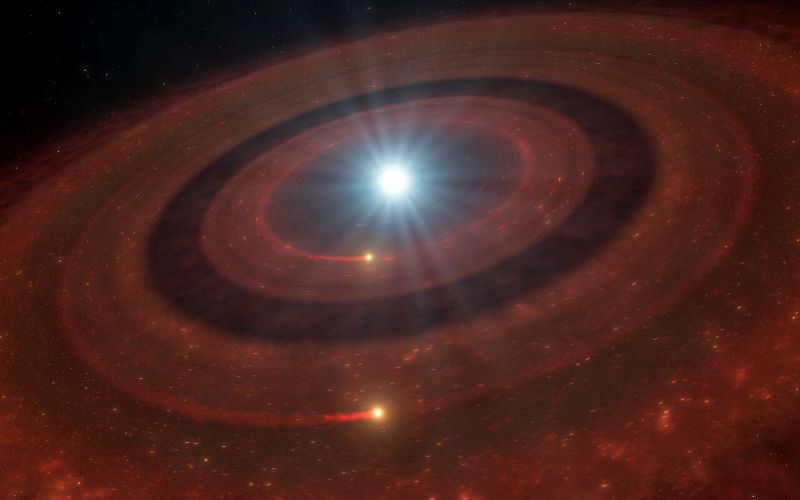
A recent discovery by astronomers using the European Southern Observatory’s Very Large Telescope has revealed a white dwarf surrounded by an unusual disc of debris. Located 1,600 light-years away, this ring of cosmic rubble provides a glimpse into our solar system's future. When a star like our sun reaches the end of its life, it expands into a red giant, sheds its outer layers, and collapses into a superdense white dwarf.
Any planets in close orbit may be torn apart during this dramatic expansion, leaving behind debris that forms a disc around the white dwarf. However, unlike typical discs, the one surrounding white dwarf J1328−1450 is composed of two distinct rings separated by a gap. The differing chemical compositions of these rings suggest they originated from different celestial bodies.
The presence of magnesium-rich and magnesium-poor rings indicates that the obliterated rocky planets were similar to those in our solar system, containing elements such as calcium, oxygen, and iron. The complex double structure may hint at the fates of the planets, with surviving planetary bodies maintaining the rings - one the size of a typical asteroid and the other the size of Pluto.
This discovery resembles the formation of our solar system, where a cloud of dust flattened into a protoplanetary disc, eventually coalescing into planets that orbit the host star. Astronomers speculate that just as our solar system began, this disc-like system may play out in reverse.
Written by urgent.news from Nautilus's reporting — not their text. Machine-written — may contain errors; check the original before relying on it.
This story
This is one outlet's version. Read the fullest account.