Illegal: Ruto's cabinet faces sack for failing to meet gender requirement
On the day his Cabinet was staring at dissolution, President Ruto announced the date of Talanta Stadium opening with a match being played by European giants Bayern Munich against Ajax Amsterdam.
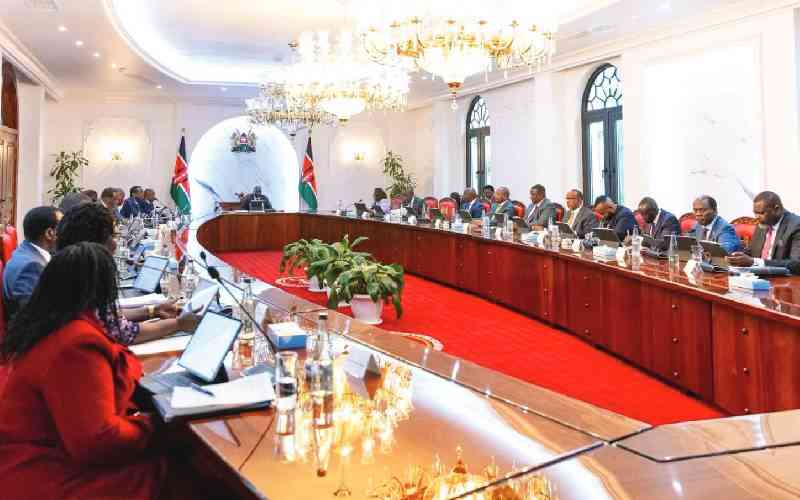
Murang’aa Senator Joe Nyutu claims that President William Ruto holds the power to resolve the gender disparity in his Cabinet at once. He emphasized that appointing Cabinet Secretaries is an exclusive prerogative of the Head of State, who has the freedom to appoint anyone at any time. Nyutu stated that the President doesn’t need to wait for another political process to address this issue, as he could appoint more women to the Cabinet right now.
"He can decide even tomorrow to meet this rule and sort out this problem," Nyutu said in an interview on Thursday, October 29, 2026.
The contention over the gender imbalance in the Cabinet has surged following the expiration of a 120-day deadline imposed by the High Court on October 28, 2026. This deadline was mandated for the government to comply with Kenya’s constitutional two-thirds gender rule, as stipulated in Article 27(8) of the Constitution. The High Court ordered President Ruto to restructure his Cabinet within the stipulated period to ensure compliance with the constitutional principle.
The deadline's expiry left the government under scrutiny for its forthcoming actions to align executive appointments with legal requirements.
On June 30, 2026, a three-judge bench of the High Court, consisting of Justices Eric Ogola, Jairus Ngaah, and Stephen Githinji, ruled that the Cabinet's gender composition was unconstitutional due to the underrepresentation of women. The 25-member Cabinet, comprising seven women and 18 men, represented just 28% women, which fell short of the required threshold.
Article 27(8) of the Constitution mandates that no more than two-thirds of members in elective or appointive bodies should be of the same gender. In this case, at least nine women were needed to meet the constitutional threshold.
Senator Nyutu also highlighted that the appointment of Cabinet Secretaries is distinct from other public offices when considering constitutional requirements. He argued that this distinction should not be overlooked. The ruling, which followed a legal challenge by civil society organizations such as Katiba Institute, CREAW, and Transparency International Kenya, challenged the Cabinet’s composition after the President made changes during the political realignments post the 2024 anti-Finance Bill protests.
While President Ruto retains the discretion to appoint Cabinet Secretaries, this power must be exercised within the boundaries set by Kenya’s supreme law. The ruling by the High Court introduces a central question for the Ruto administration: How can the President exercise his appointment powers while adhering to the constitutional requirement for gender representation?
The judge’s decision on the Cabinet’s gender composition upheld other aspects of the Cabinet’s formation, including the reappointment of former Cabinet Secretaries and the inclusion of opposition-affiliated politicians. Nevertheless, the issue of gender imbalance remains a significant concern. The debate surrounding gender equality in Kenya’s public appointments and the enforcement of constitutional obligations against the Executive is now at the forefront.
Senator Nyutu posits that the President already possesses the authority needed to rectify the situation, suggesting that a fresh political process is not necessary. The immediate focus now is on whether President Ruto will amend the Cabinet by appointing more women, reducing the number of men, or employing a combination of both strategies to meet the constitutional threshold.
With the deadline having passed, the government is under increasing pressure to demonstrate compliance with the court order and uphold the two-thirds gender principle. Women’s rights advocates view this dispute as a critical test for whether constitutional guarantees on equality and representation will materialize into tangible participation in national leadership.
President Ruto’s subsequent actions will determine the future composition of the Cabinet and set a significant precedent for enforcing gender balance in Kenya’s appointive public bodies.
Written by urgent.news from People Daily Kenya's reporting — not their text. Machine-written — may contain errors; check the original before relying on it.
This story
This is one outlet's version. Read the fullest account.