Boffin's software found a possible dwarf planet - a result so rare he thought it must be a bug
2026 ED138 is way out beyond Neptune and perhaps the smallest known object of its type
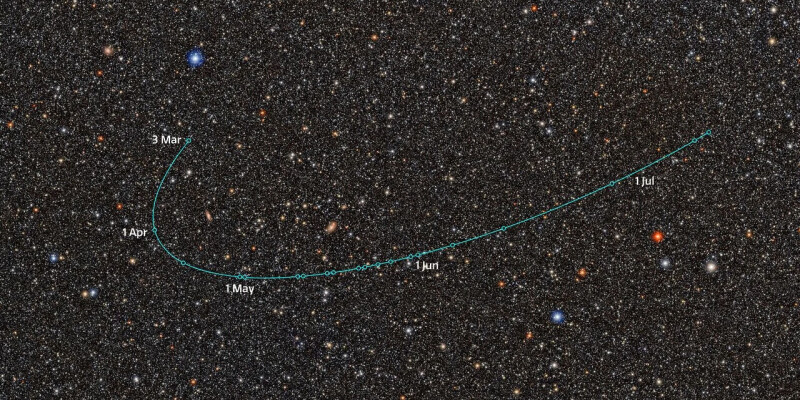
A scientist working on data from the Rubin Observatory has discovered what may be the solar system's sixth known dwarf planet. The observatory, operated by the USA's National Science Foundation and Department of Energy, boasts the 3200-megapixel Legacy Survey of Space and Time (LSST) Camera, which captured the data. Matthew Holman, a member of the Rubin Operations team and project contributor from the Center for Astrophysics (CfA) at Harvard & Smithsonian, developed specialized search code to analyze the data and identify potential dwarf planets.
The code, designed to compare billions of detections of moving objects, spotted a particularly bright and distant object on October 13, which appeared unusually large. Holman was initially skeptical, thinking it might be a bug in the code, but after thorough checks and review by other experts, the discovery was confirmed. The object, named 2026 ED138, is located roughly 46 astronomical units (au) from the Sun, with one au being the distance from Earth to the Sun.
For context, Pluto's orbit averages 40 au. The Minor Planet Center, an organization that tracks near-Earth objects, reviewed the findings and published extensive data about ED138's orbit. To be classified as a dwarf planet, an object must be large enough to assume a nearly round shape under its own gravity and have not cleared its orbit of debris.
The IAU, the organization that defines these terms, recognized 2026 ED138 as a strong candidate for dwarf planet status. Scientists estimate ED138's diameter to be between 600 and 1500 kilometers, potentially making it the smallest dwarf planet ever observed. However, if the upper estimate is accurate, it would be smaller than Pluto, Eris, and Haumea but larger than Makemake and Ceres.
The observatory attributes ED138's detection to its extensive, continuous monitoring of the Southern Hemisphere sky and its powerful algorithms that sift through immense amounts of data to identify small moving objects amidst a crowded field of stars.
Written by urgent.news from The Register's reporting — not their text. Machine-written — may contain errors; check the original before relying on it.