A New Kind of Chemistry
Thanks to Kyle Schiller at Marathon Fusion for conversations and information that informed this essay.
Modern society relies heavily on chemical reactions, whether to craft new materials or generate energy. These reactions manipulate atoms by altering how their outermost electrons are arranged. A simple example is sodium and chlorine combining to form sodium chloride, or table salt. The atom's core nucleus, containing protons and neutrons, remains untouched during this process.
Under specific conditions, atoms can undergo nuclear reactions that rearrange their interior. In nuclear fission, the nucleus splits, forming new atoms and releasing vast amounts of energy, as seen in nuclear power plants. Conversely, nuclear fusion combines hydrogen atoms, merging their nuclei into helium. High-energy particle collisions in devices like the Large Hadron Collider also serve this purpose, enabling scientists to examine resulting fragments.
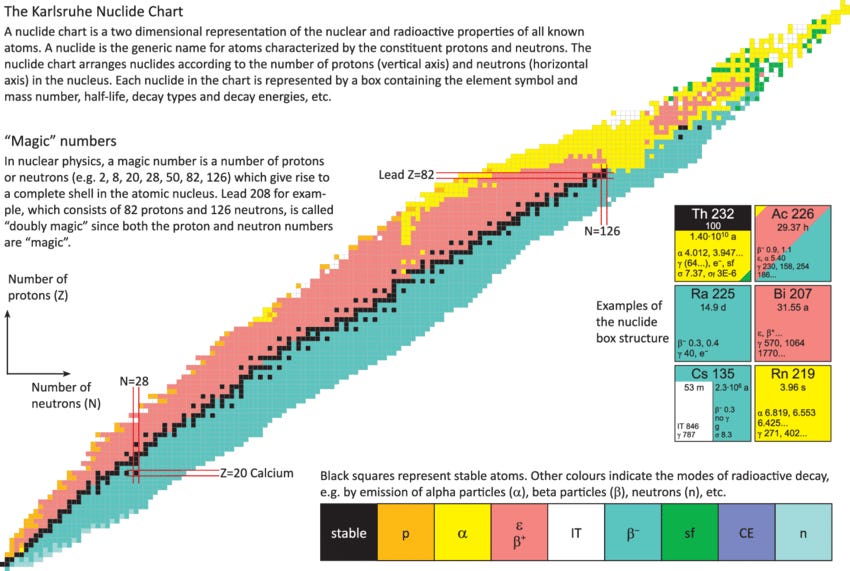
By adjusting the count of protons or neutrons in an atom's nucleus, distinct isotopes of the same element can be generated. Isotopes are alternative forms of an element with varying numbers of neutrons, leading to different atomic masses. Some isotopes are inherently unstable, decaying over time into more stable forms and emitting radiation, which can be utilized in various applications.
Carbon dating, for instance, determines the age of organic materials by measuring the decay of carbon-14, an isotope with eight neutrons. Similarly, radiographic welding inspection utilizes radioactive isotopes like iridium-192 and selenium-75 to emit gamma rays, ensuring weld integrity. Smoke detectors leverage americium-241, an artificial isotope, to trigger alarms when smoke disrupts the flow of electricity.
Despite their potential, isotopes are currently costly and scarce, as producing them is complex and expensive. For instance, technetium-99m, commonly used in medical imaging, is derived from molybdenum-99, which is scarce due to limited availability in nuclear reactors. The ability to manufacture isotopes more efficiently and affordably could revolutionize medical treatments, nuclear power, and material science.
Written by urgent.news from Construction Physics's reporting — not their text. Machine-written — may contain errors; check the original before relying on it.