Zukunftsgestalter: Trumpf auf dem Weg zum Maschinen-Menschen
Für Trumpf reicht es nicht mehr, nur die besten Laser zu bauen. Was im Kampf gegen chinesische Konkurrenten zählt, sind Gesamtsysteme mit Robotik. Trumpf erobert das neue Feld mit KI.
In the development hall of Trumpf in Ditzingen, the revolution of robotics does not begin with a spectacular-looking robot. It begins when machines stop being pre-programmed in every movement and start deciding for themselves. Robotics is not the core theme of the family business, which specializes in laser use, from sheet metal processing to chip production.
However, in the DNA of the company is always to keep an eye on the latest technologies, maintaining close contact with research and science. The secret to Trumpf's success is making industrial robots more intelligent. They are supposed to complement sheet metal processing machines with an intelligent system, creating competitive advantages.
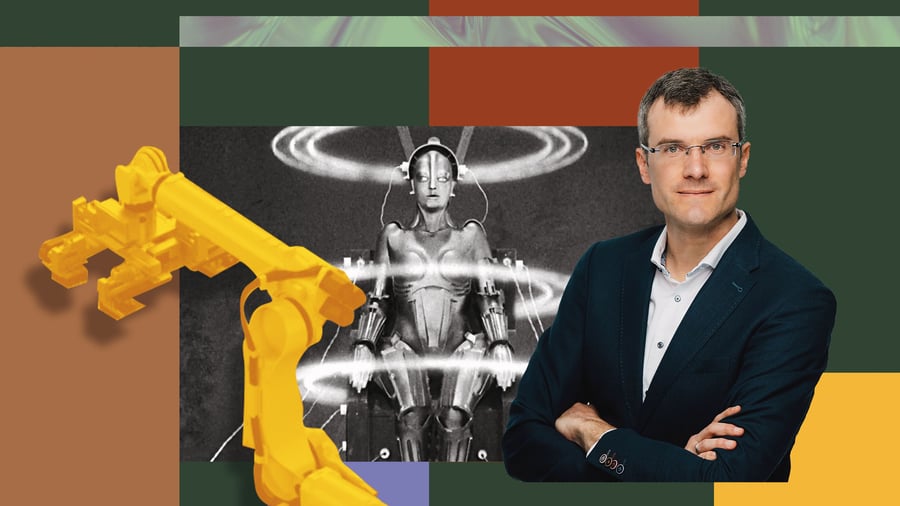
The Chinese competition is now posing a threat to the world market leader. The Handelsblatt has received exclusive insights into the sensitive area of Trumpf for the series "Future Makers." When people think of the image of the machine man from the legendary silent film classic "Metropolis" from 1927 or the golden Star-Wars robot C-3PO, who would undoubtedly look disappointed at the sight of the development hall of Trumpf.
"In the factory, a robot does not have to look like a human," says Ralph Lange, Robotics Chief of the Mid-sized Company. "If he needs only one arm, he has only one, if he needs three, he has three. If he needs no head, he has no head." The intelligence could be somewhere in the robot's inner or in the cloud. Ultimately, it is about making robots smarter at Trumpf.
The technological jumps in such extremely technical devices as industrial robots nowadays happen primarily in software. Around 600 developers for their own software have Trumpf, in addition to a KI team with twelve people in the headquarters and another 90 distributed worldwide. "AI is no spectator sport," says Sarah Engel, "Head of AI" at Trumpf.
"We involve all employees. There is a mandatory training, but we rely on curiosity and showcase applications on the spot." The Trumpf Method: The Way to the Light Neugierde and Eigenentwicklung have always been two important driving forces in the Trumpf cosmos. Even in his diploma thesis in 1957, Berthold Leibinger laid the foundation for his first invention.
The copying and nibbling machine allowed him, for the first time, to quickly and precisely copy contours and samples of metal parts based on a template. This brought him the nickname "Nibbler King" when he died in 2018 and laid the foundation for his rise to the world conglomerate. He sold his patents to pay for shares in the company until it finally belonged to the patriarch's patron, Christian Trumpf.
In the late 70s, Leibinger recognized the potential of lasers for sheet metal processing. He bought American lasers and refined and stabilized the technology, making it suitable for mass production. Today, Trumpf, headed by his daughter Nicola Leibinger-Kammüller, is the world leader in industrial lasers. Their applications go far beyond sheet metal cutting, ranging from phone glass processing to ultrashort pulse lasers, EUV lasers, and plasma generators, without which the latest and most powerful chips could not be produced.
No other company can do this. With semiconductor technology alone, Trumpf generates a billion euros. The company has built an entirely new foundation with semiconductor technology within 20 years. One of the latest future projects with the partner Rohde & Schwarz are laser defenses for drones. However, not everything Trumpf does works out.
Some experiments with new technologies have been discontinued. The 3D metal printers were sold, as was the photonics sensorics acquired from Philips a few years ago. But for the Trumpf management, such failures are part of the process. "We will always adapt to new technologies and circumstances of the world, even if we don't go chasing after them," Mathias Kammüller states as the basic principle of the Swabian company.
In management, the husband of the CEO is responsible for digitalization. "We have always integrated new technologies into our products to move forward." Robots help the tool machines. Customer replacement part orders are already largely processed by AI at Trumpf. However, AI hits its limits. "If it's about causes of damage, the direct exchange of the customer with the service specialist is safer, as AI sometimes says something even when it doesn't know and starts fantasizing," says Tool Machine Chief Stephan Mayer and adds "yet" for emphasis.
Written by urgent.news from Handelsblatt's reporting — not their text. Machine-written — may contain errors; check the original before relying on it.