Romans Made Color-Changing Glass With Ancient Nanotechnology. Scientists Just Discovered How to Replicate the 1,600-Year-Old Marvel
Researchers were inspired by Lycurgus Cup, a chalice from the fourth century C.E. that appears opaque green under reflected light but wine red when lit directly. "To me, it’s magic," the lead researcher says
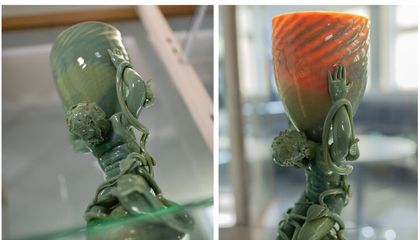
The Romans crafted a color-changing glass centuries ago, a feat re-created by modern scientists using ancient nanotechnology. This marvel, known as the Lycurgus Cup, was discovered to transform from jade green to blood red depending on the lighting conditions. The cup, created in the fourth century CE and currently housed at the British Museum, features mythological scenes from Homer’s Iliad.
Scientists believe the color-changing effect was achieved by incorporating nanoparticles of silver and gold into the glass. These nanoparticles, being smaller than visible light wavelengths, interact with light in unique ways—blocking certain colors while allowing others to pass through. Under direct light, the gold and silver particles absorb blue and green light, only permitting reds and oranges to be seen.
Conversely, when light is reflected off the glass, the particles scatter the light, resulting in the opaque green appearance observed.
Despite understanding the basic principle behind the Romans’ technique, reproducing it was no easy task. It required numerous trials and errors to find a suitable recipe that could consistently produce the desired effect using the raw materials available to Roman artisans. The color's sensitivity to furnace position suggests it would have been challenging for Roman artisans to control consistently, hinting at the cup’s remarkable craftsmanship.
In 1960s, researchers successfully created a version of dichroic glass, but the newly developed glass by Lisa Hollands at the University of Sheffield is more precise and better matches the Lycurgus Cup’s color. British glass artist Elliot Walker then took the research further by creating a sculpture inspired by the Lycurgus myth and a Roman Farnese Atlas sculpture, replacing the latter’s globe with a cup.
The sculpture, set to be displayed at the University of Sheffield’s Festival of the Mind and permanently exhibited at the Turner Museum of Glass, highlights the artistic and scientific significance of the recreated ancient glass.
Written by urgent.news from Smithsonian's reporting — not their text. Machine-written — may contain errors; check the original before relying on it.
