OData at Scale: When to Use CDS Views, RAP, or API Business Hub in Hybrid SAP
Choose between CDS-view OData, custom RAP services, and API Business Hub in hybrid SAP landscapes, with Cloud Connector, security, and performance trade-offs.
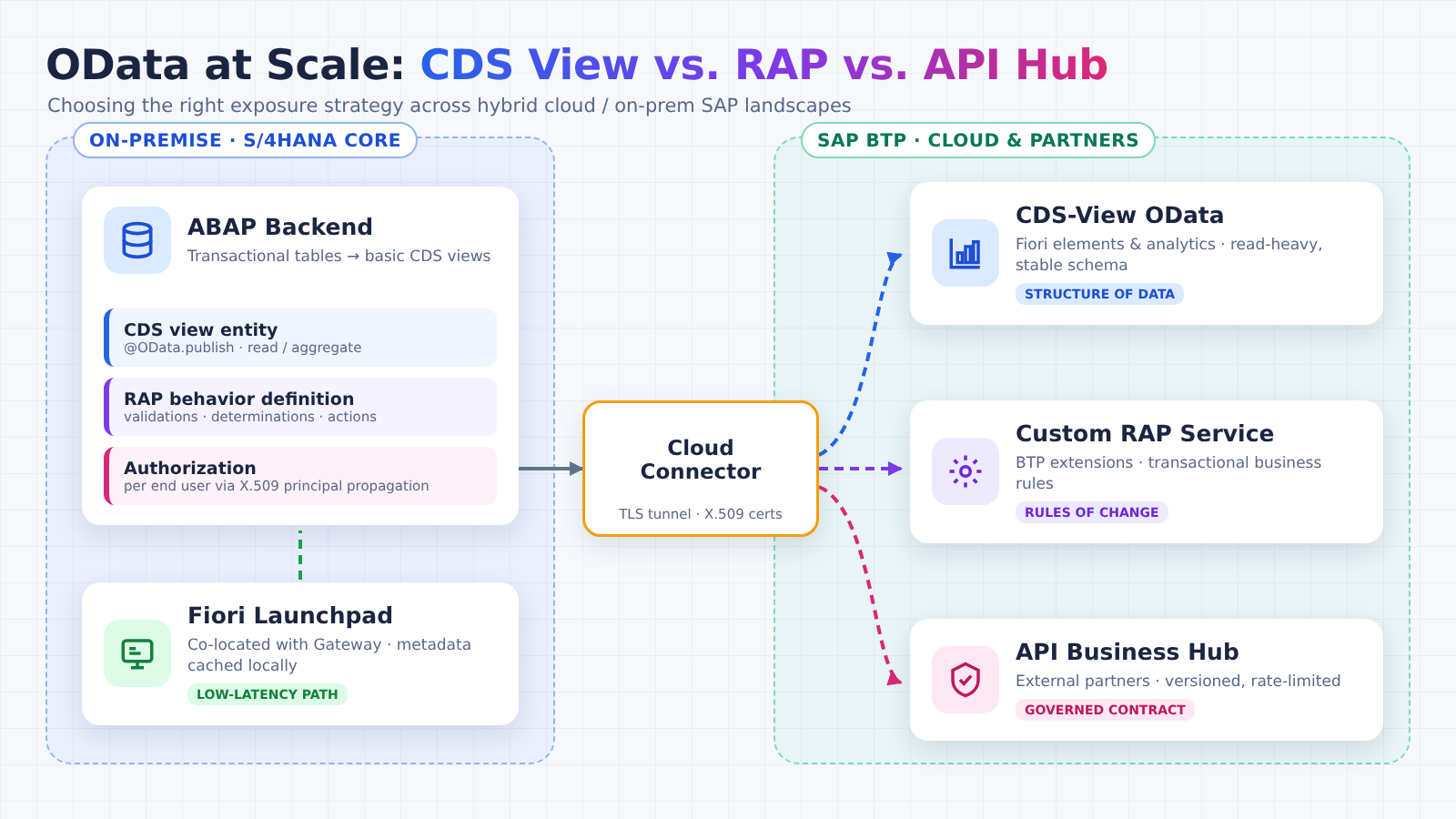
When deciding on the appropriate OData strategy for Fiori apps, BTP hosted extensions, and third-party integrations in a hybrid SAP environment, it is essential to consider three distinct factors: transaction complexity, consumer type, and governance requirements. These three strategies are CDS view-based exposure, custom RAP-based services, and SAP API Business Hub published APIs.
CDS views, also known as Custom Transactional Services, are best suited for read-heavy Fiori and analytical use cases. They are generated services that map CRUD operations onto the view with minimal custom code, making them efficient for simple read functions. However, when transactional behavior is required, CDS views may not be the best choice as they can become complex and difficult to maintain.
Custom RAP-based services are designed to handle more complex business processes and transactional logic. They are built using the ABAP RESTful Application Programming Model layer that provides validations, determinations, actions, and generated persistence for managed scenarios. RAP is a more robust solution for handling transactional logic, but it may not be the optimal choice for read-heavy or consumer-focused scenarios.
The third strategy involves leveraging SAP API Business Hub, now part of the SAP Business Accelerator Hub, or API Management for governance and discoverability purposes. These solutions come into play once the OData service is consumed by external parties or third-party integrations. The API Business Hub provides features like catalog and versioning management, quota, and discoverability, ensuring that the service remains secure, performant, and easily accessible.
Latency differences across the hybrid boundary also impact the decision-making process. On-premises calls have a different latency profile compared to calls that go out to BTP and back, as they involve additional steps such as TLS negotiation and certificate-based authentication through the Cloud Connector. When dealing with BTP extensions, it is essential to consider these latency differences when choosing an OData strategy.
Data volatility and transactional integrity are other critical factors that influence the selection of the appropriate OData strategy. CDS views work well for straightforward data changes such as master data, aggregates, or configuration. However, when transactions involve complex rules that span several fields or have side effects requiring reliable execution, CDS views may struggle. RAP, on the other hand, is designed to handle more complex business transactions and ensure data integrity.
In conclusion, the decision to use CDS views, custom RAP-based services, or SAP API Business Hub published APIs in a hybrid SAP environment depends on transaction complexity, consumer type, and governance requirements. Each strategy has its strengths and weaknesses, and understanding these factors will enable organizations to design effective OData solutions that cater to their specific needs in a hybrid SAP landscape.
Written by urgent.news from HackerNoon's reporting — not their text. Machine-written — may contain errors; check the original before relying on it.