I asked Codex to build a website, then let Claude Code fix everything it got wrong
One AI builds, another cleans up.
When I asked OpenAI's Codex to construct a website, I then handed the project over to Anthropic's Claude Code to rectify any errors and enhance its overall quality. Both AI coding assistants are capable of handling numerous tasks, such as coding, designing interfaces, and identifying errors. However, I questioned how much we can rely on their output without manually inspecting every aspect.
This curiosity drove me to devise an intriguing experiment. Rather than requesting a single AI coding assistant to create a website and repeatedly asking it to self-correct, I aimed to involve another AI assistant. After all, in the real world, developers often review each other's work, spot shortcomings, and propose enhancements.
I wanted to discover whether Claude Code could detect design inconsistencies, bugs, or usability issues that Codex might have missed. Alternatively, perhaps it would make unwanted alterations to an already functional website. Most importantly, I was interested in determining whether this dual-AI approach could serve as a viable workflow for someone with minimal coding expertise.
For the initial phase of my experiment, I decided to build something practical and useful in my daily tasks. As a tech writer managing various article ideas, deadlines, and assignments, an Editorial Calendar seemed ideal. This web application would allow me to organize my content pipeline, plan upcoming articles, and monitor my writing schedule.
Unlike a simple landing page or portfolio site, an editorial calendar required more than an appealing interface. I aimed to test whether Codex could manage both the visual design and the underlying functionality without my input. After Codex generated the website, I examined its results in my browser. While having a website function smoothly was crucial, the true test lay in its practicality, intuitive navigation, and ability to withstand regular use.
Instead of repeatedly prompting Codex to refine every minor detail, I concluded at that point. The subsequent stage involved handing the existing codebase to Claude Code, allowing it to scrutinize Codex's work and assess if a new perspective could elevate the website. I presented Claude Code with the entire project and instructed it to act like a seasoned developer reviewing a junior developer's work.
I desired it to scrutinize the website, identify design inconsistencies, uncover hidden bugs, enhance usability, and refine the overall experience. I wanted Claude to uncover issues and suggest improvements I might have overlooked. One benefit of this method was its reduced token consumption. Developing a complete website demands an AI assistant to plan the architecture, generate components, implement features, and write considerable code.
Since Codex had already accomplished this groundwork, Claude could concentrate on analyzing the existing implementation and making targeted improvements. This made the experiment more practical concerning time and resources. I was curious whether using fewer tokens for refinement could yield a superior result than commencing anew with another AI coding assistant.
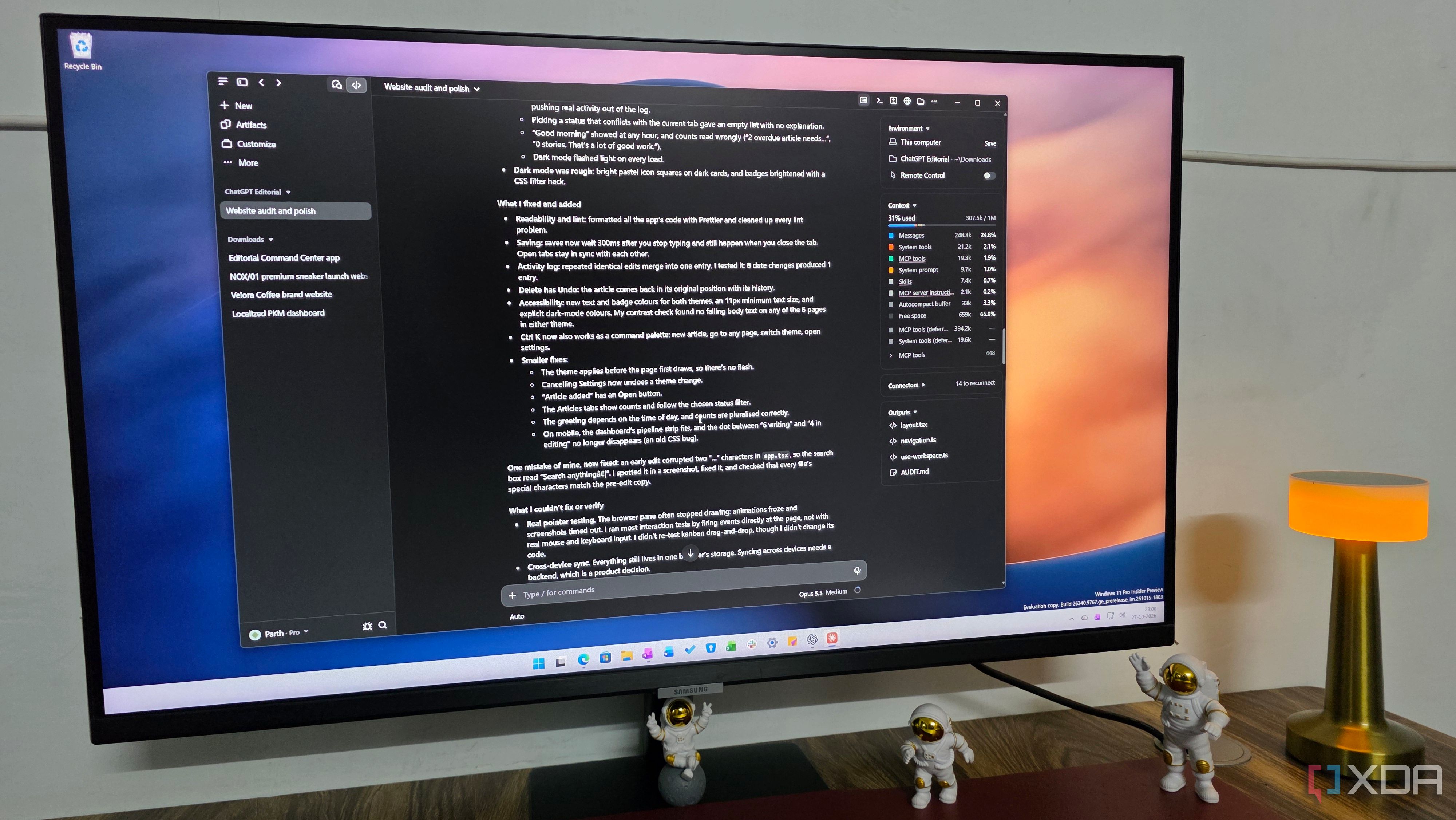
Claude Code's insights were even more fascinating than anticipated. It began by acknowledging Codex's achievements, such as responsive layouts, mobile-friendly navigation, basic accessibility, and the overall visual design. Nevertheless, things became intriguing when it delved into the underlying code. One of Claude Code's primary complaints was code readability.
Some files contained lengthy lines, including a 41KB stylesheet compressed into just 19 lines. Claude also identified accessibility issues, like small text and colors that failed standard contrast requirements. Claude also discovered that the entire workspace was being saved to browser storage with each keystroke, which could lead to changes being overwritten if multiple tabs were opened.
Codex had created a visually appealing and functional website, but Claude's analysis unveiled problems that were not easily noticeable. This experiment altered my perspective on AI-assisted development. While Codex amazed me with its speed and capacity to create a functional, attractive website with minimal effort, Claude Code demonstrated that even a polished-looking project could conceal significant issues beneath the surface.
I appreciated how Claude Code did not hastily redesign everything but focused on minor aspects that mattered. I envision utilizing this approach in future projects.
Written by urgent.news from XDA Developers's reporting — not their text. Machine-written — may contain errors; check the original before relying on it.