How the biggest Alzheimer’s risk gene disrupts the process of insulating neurons
MIT researchers showed that the APOE4 gene variant suppresses molecular signaling needed for oligodendrocytes to myelinate neurons and also demonstrated a proof-of-concept fix.
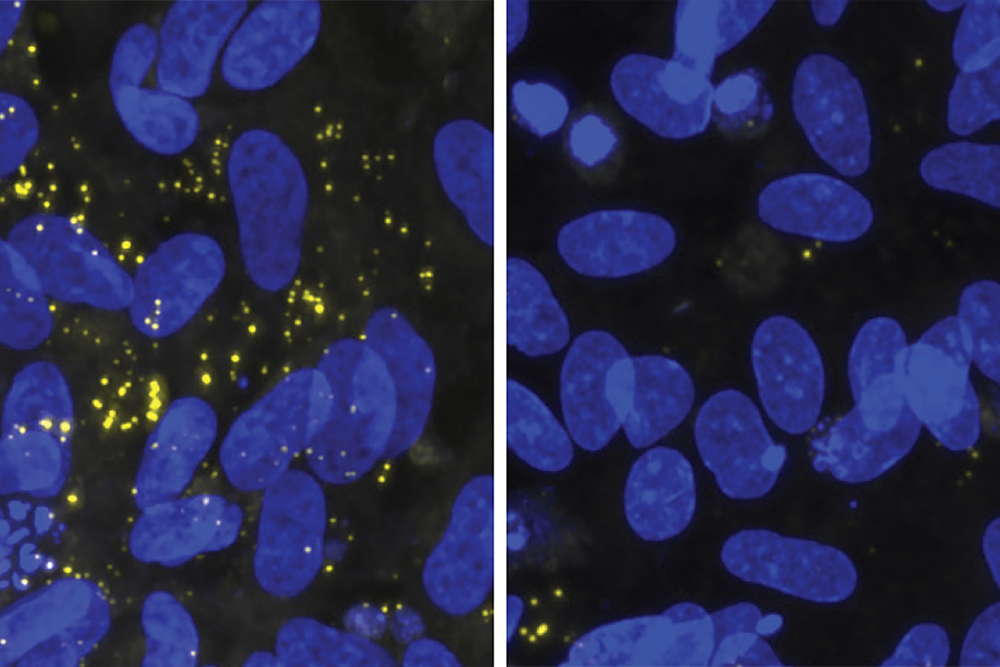
The APOE4 gene variant, a major genetic risk factor for late-onset Alzheimer's disease, disrupts brain function by interfering with the process of insulating neurons with a fatty sheath called myelin. A new study published in Cell Stem Cell reveals that APOE4 leads to a suppression of Wnt signaling in oligodendrocyte cells responsible for producing myelin.
When Wnt signaling is impaired, these cells gather lipid droplets instead of properly myelinating the axon branches of neurons. Restoring Wnt signaling in APOE4-carrying oligodendrocytes, both in human cell cultures and mice models of Alzheimer's disease, restored myelination. The research team, led by MIT neuroscientists Li-Huei Tsai and Leyla Akay, discovered the key role of Wnt signaling through multiple methods, including CRISPR gene editing, which systematically knocked out each protein-coding gene in APOE4-carrying oligodendrocytes.
This screen identified that Wnt-promoting genes lacking led to lipid droplet accumulation, while Wnt-suppressing genes lacking also caused lipid droplets. The study further revealed that APOE4 causes lipid droplet accumulation in oligodendrocytes due to dysregulation of the Wnt signaling pathway. Reduced beta-catenin expression and excessive GSK3b expression in APOE4 oligodendrocytes suppress Wnt signaling.
The team then tested interventions that manipulate GSK3b activity, showing that inhibiting GSK3b with a chemical called CHIR99021 can restore Wnt signaling, myelination, and neural axon growth in APOE4-carrying cells. In mice carrying the APOE4 gene and modeling Alzheimer's pathology, treatment with CHIR99021 reduced lipid droplets and increased myelination in the hippocampus, a memory-making region of the brain.
Written by urgent.news from MIT News Research's reporting — not their text. Machine-written — may contain errors; check the original before relying on it.