Neuroscience gave AI its start. What happens now?
David Sussillo maps the two fields' divergent paths, and where they might still meet.
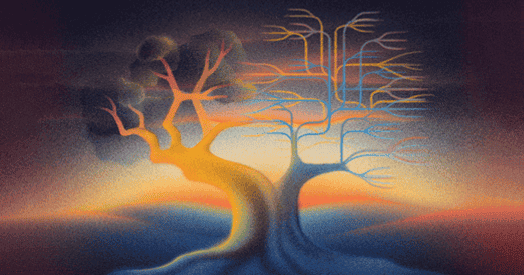
Neuroscience and artificial intelligence (AI) share a deep-rooted history that dates back to the mid-1940s when Warren McCulloch and Walter Pitts first conceived the idea of an artificial neuron. This novel concept was inspired by the electrical properties of biological neurons, creating a common ground between the two fields. As time progressed, AI made significant advancements, and the connectionist approach, which emphasized the importance of connections between neurons, became a driving force. This led to a series of developments that caused these fields to diverge.
David Sussillo, a computational neuroscientist with extensive experience at Google Brain and Meta Reality Labs, has observed the changing relationship between neuroscience and AI. While he acknowledges that neuroscience initially provided the inspiration for AI, this connection has become less prevalent in recent decades. AI researchers began to focus more on the technical aspects of neural network models and their functioning, leading to a shift in the shared objectives of the two disciplines.
Sussillo argues that neuroscientists can contribute to understanding AI, given their extensive experience in understanding the brain. However, he believes that the involvement of neuroscientists in AI understanding has been less successful, primarily because AI technologies evolve rapidly, driven by engineering principles rather than solely scientific ones. Additionally, AI systems require a diverse set of disciplines for full understanding, and neuroscientists can play a crucial role in this collaborative effort.
As AI systems become more sophisticated, especially with the advent of chain-of-thought reasoning and language-based models, the need for neuroscientists to engage in AI research becomes even more apparent. These new AI capabilities allow for more cognitive-science-oriented inquiries and provide an opportunity for neuroscientists to explore these aspects further.
Thus, the future of AI understanding lies in collaboration between neuroscience, cognitive neuroscience, and other technical disciplines. Graduate students should be encouraged to participate in AI internships, as this exposure can lead to innovative approaches and interdisciplinary solutions in both fields.
Written by urgent.news from The Transmitter's reporting — not their text. Machine-written — may contain errors; check the original before relying on it.