Justice Ayesha Malik challenges assumptions blaming women for 'inviting' rape
ISLAMABAD: Supreme Court’s (SC) Justice Ayesha Malik on Tuesday challenged victim-blaming assumptions that suggested that women ‘invite’ rape and called for such attitudes to be re-examined. The judge was addressing participants at the launch of a bench book on the adjudication of rape cases for judges of gender-based violence (GBV) courts in Islamabad. The event was held in collaboration between…
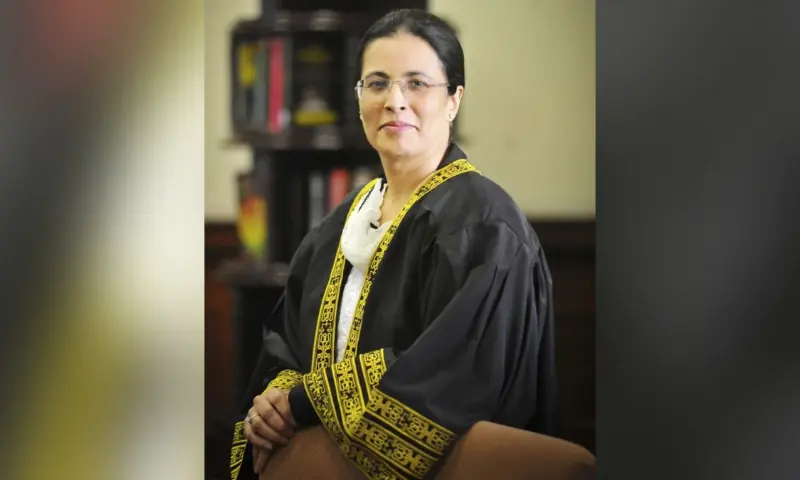
Supreme Court Justice Ayesha Malik tackled the issue of victim-blaming attitudes that suggest women 'invite' rape, during a recent event held in Islamabad. The judge's comments came during the launch of a bench book aimed at guiding judges in adjudicating rape cases, particularly those involving gender-based violence (GBV). The event was organized by the Ministry of Human Rights (MoHR), the Legal Aid Society (LAS), and the United Nations Population Fund (UNFPA).
Speaking at the launch, Justice Malik expressed concern that sexual violence had become so commonplace that it no longer generated strong public outrage. She criticized the notion that female victims of sexual violence had somehow 'invited' the assault, advocating for a fundamental re-examination of societal attitudes that enable such assumptions.
The bench book, which was released alongside a national study on low conviction rates in GBV cases, serves as a practical reference to ensure fair trials and judicial decisions based on law and evidence.
The study, conducted by the MoHR alongside the Senate's Functional Committee on Human Rights, examined the various stages where cases falter, from the initial report through investigation, medico-legal examination, prosecution, and trial. The bench book, presented by LAS Director of Gender, Inclusion, and Development Advocate Maliha Zia, provides a comprehensive guide for judges throughout the trial process, aligning with the 2021 Anti-Rape Investigation and Trial Act.
The act's chairperson, Senator Ayesha Raza Farooq, emphasized the importance of implementing the legislation and understanding its implications.
Advocate Haya Emaan Zahid, LAS CEO, highlighted the pressures faced by survivors, including delayed reporting, gaps in medical evidence, and family power dynamics, and the need to consider these factors in context. Dr. Luay Shabaneh, UNFPA Pakistan's Representative, connected fair adjudication to Pakistan's international human rights commitments, stating that a well-reasoned judgment protects individuals both within and outside the courtroom.
British High Commission Senior Governance Adviser Mary Kate Thomson stressed the role of public trust in the handling of everyday cases, which influences whether survivors come forward.
Addressing the broader issue, Abdul Khalique Shaikh, Ministry of Human Rights secretary, acknowledged that the gap between legal protections on paper and their practical application remains significant. The event, attended by various stakeholders, aimed to bridge this gap and ensure that legal protections are consistently delivered throughout the justice process. According to the Sahil's Six Months Cruel Numbers Report, 3,172 GBV cases were reported in Pakistan during the first half of 2026, including 21 other crimes.
Written by urgent.news from Dawn's reporting — not their text. Machine-written — may contain errors; check the original before relying on it.