Global carmakers search for new China strategy as market share slips below 30%
Global carmakers are searching for a way to survive in China’s cutthroat market, as they continue to lose ground to domestic competitors in a landscape that is increasingly tilting towards electric vehicles. International auto brands from Volkswagen to Toyota saw their market share in the Chinese mainland slide once again in the third quarter of the year, as consumers turned away from expensive…
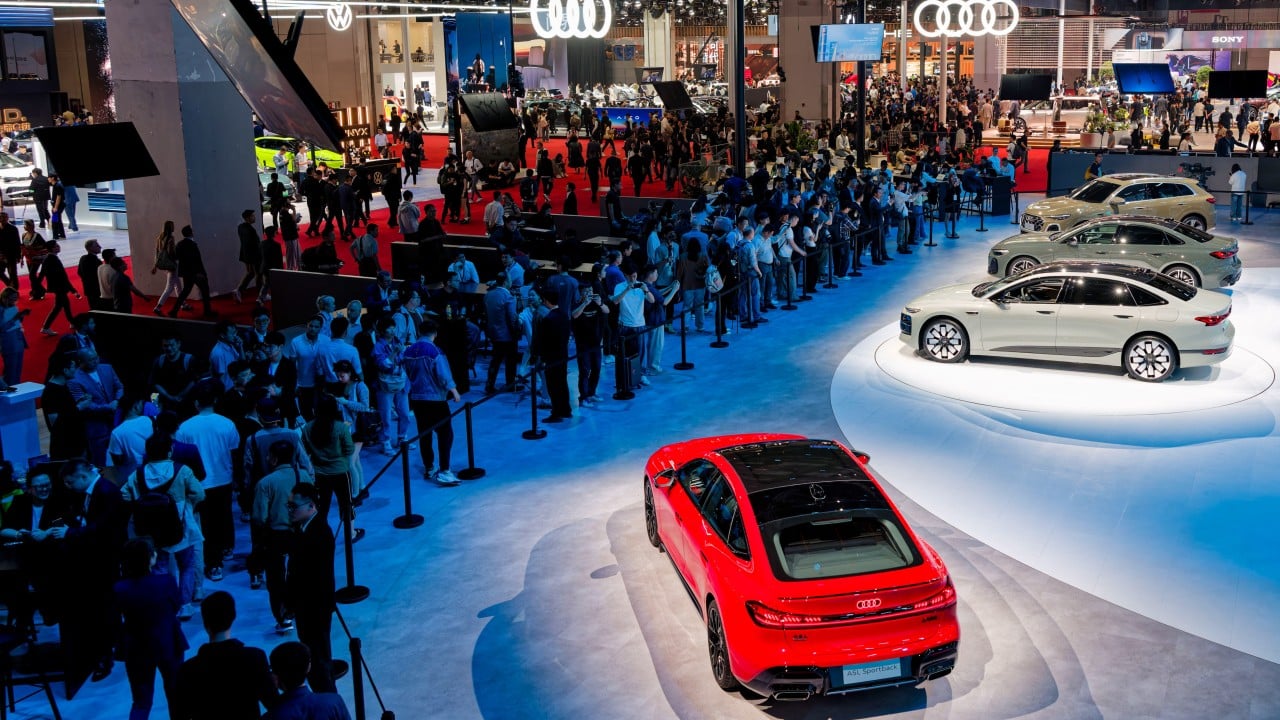
Global car manufacturers are grappling with a challenging situation in China, where their market share has dipped below 30% for the first time in years. This decline is attributed to several factors, including a weak market, reluctance to purchase expensive foreign vehicles due to an economic slowdown and high petrol prices caused by geopolitical conflicts.
According to the China Passenger Car Association (CPCA), foreign brands recorded less than 30% of deliveries in the third quarter, down from 34.6% the previous year. Foreign marques delivered only 1.38 million cars to mainland customers during this period, as reported by the CPCA.
Eric Han, a senior manager at Shanghai-based consultancy Suolei, stated that international brands have failed to make a comeback in the current market where consumers are hesitant to spend on high-priced vehicles. The decline in demand for foreign-branded cars can be attributed to China's rapid adoption of electric vehicles (EVs), with EV adoption rates reaching an all-time high of 67% in September, up from 57.9% a year earlier.
Global carmakers are largely lagging behind Chinese brands in the domestic EV market, with Tesla being the sole exception.
While global brands remain ahead of their Chinese rivals in the petrol vehicle segment, analysts believe they will struggle to revive their fortunes in China without producing more intelligent vehicles to appeal to local consumers. To achieve this, companies like Volkswagen and Nissan must incorporate Chinese EV technologies to assemble cars under their brands.
Zhao Zhen, a sales director at Shanghai-based auto dealer Wan Zhuo Auto, emphasized that establishing new EV-branded entities would be crucial for foreign manufacturers to capture market share in China, but consumers may not be convinced by these EVs as the market is already saturated with value-for-money models from domestic brands.
Audi, a premium brand under the Volkswagen Group, recently unveiled a dual-brand strategy for the Chinese market, following a 19% year-on-year decline in its deliveries during the first half of 2026. The company's joint venture with Chinese auto giant FAW Group in Jilin province will focus on models under its traditional four-ring logo, while another joint venture, SAIC Audi in Shanghai, will adopt the all-caps AUDI name.
Audi's dual-brand strategy aims to streamline new model development cycles and enhance customer experiences in the future.
Written by urgent.news from South China Morning Post's reporting — not their text. Machine-written — may contain errors; check the original before relying on it.
This story
This is one outlet's version. Read the fullest account.