Francia debe “salir adelante por sus propios medios” sin incurrir en más gastos
El ministro de Economía francés, Roland Lescure, sostiene que el Gobierno puede encontrar soluciones creativas sin aumentar el déficit presupuestario. Leer
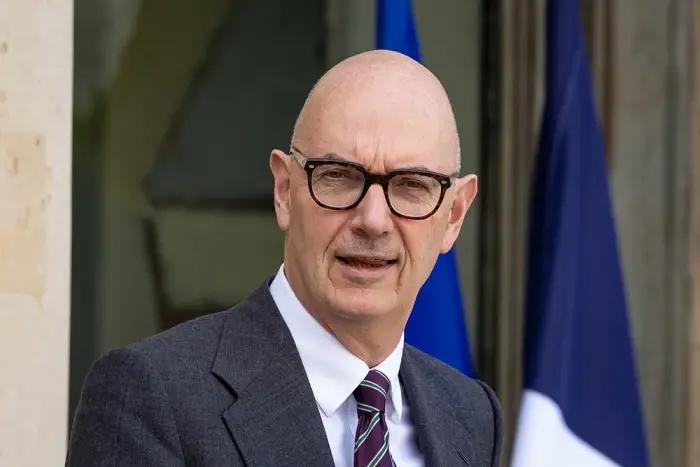
The French Minister of Economy, Roland Lescure, asserts that the government can devise creative solutions without increasing the budget deficit. France must prove to bond markets that it is not the sick man of Europe by approving a 2027 budget and appeasing protests without additional spending, according to Lescure. "We need to demonstrate that we can move forward on our own," he says.
Recovering consumer and business confidence is crucial to reinvigorate growth. France's borrowing costs have reached levels unseen in a quarter of a century as markets penalize the country for its inability to control public spending. Investors in bonds also worry that the April presidential elections, in which far-right leader Marine Le Pen is leading the polls, will bring greater instability and make fiscal consolidation even more challenging.
Last week, the government received an unexpected break when Moody's decided not to downgrade France's credit rating, a move many expected. According to Lescure, the decision is a vote of confidence in the French economy: "Moody's has reminded us that France faces challenges to address, but also has assets." The widespread and sometimes violent protests over the past weeks have unsettled the social climate, increasing pressure on a government caught between market demands and street unrest.
Secondary school students' protests, which began weeks ago due to poor educational conditions, have led to broader discontent over the high cost of living and the government's management under President Emmanuel Macron. The government typically responds to street protests by increasing public spending, as it did in 2019 when it offered 17 billion euros in tax cuts and support measures to quell the "yellow vest" movement.
When asked if the government will have to adopt a similar measure now, Lescure states that it is not possible given the deficit situation and market pressure. "We don't have the money, so we must be creative." Lescure highlights recent plans to reduce fuel costs as an example of the government's creative solutions. Last week, Macron secured an additional 300,000 metric tons of diesel monthly from Eastern Mediterranean producers, and previously managed the release of additional strategic gas and diesel reserves.
On Monday, Prime Minister Sébastien Lecornu announced a series of concessions for students, including 15,000 new university and vocational training spots, 1 billion euros over five years for universities, and 4 billion euros in loans for regions to accelerate the renovation of educational centers. Protesters and unions continue to pressure the government for more measures against the rising cost of living.
More protests are planned for Saturday and the following Thursday. When asked if the government will have to do more, Lescure notes: "We will see what we need to do. What I can assure is that any additional spending must be offset with greater savings." France's 2027 deficit target is 5% of GDP. France's deficit reached 5.1% of GDP last year, the second-highest in the eurozone behind only Belgium, and is expected to rise to 5.4% this year.
France's 10-year bond yield reached 5% last week, recovering significantly on Monday after Moody's' decision. The risk premium compared to German bonds has roughly doubled in the last three months. Referring to the impact of hedge funds and other market operators, Lescure says the strong short-term pressure on French bonds at the beginning of this month was "mainly due to the liquidation of carry trade operations".
These operations, typically betting on French bonds yielding more than German bonds or via interest rate swaps, were disrupted as yields rose, intensifying short-selling pressure on the bonds. "I'm not sure if the market has fully stabilized yet, but the situation has indeed been quite complex," Lescure explains. The government has proposed a budget for next year aimed at reducing the deficit, which includes 43 billion euros in spending cuts and tax increases, but lacks the necessary majority for approval in Parliament.
In recent weeks, lawmakers have introduced amendments and rejected much of the spending cuts. However, Lescure downplays these actions and asserts that the government has constitutional mechanisms to bypass Parliament, such as Article 49.3, which allows the executive to pass a law without parliamentary support if it survives a censure motion, and the ability to approve the budget by decree.
Lescure acknowledges that the use of these institutional safeguard mechanisms may be necessary, though he does not believe anyone will view it as a constitutional coup d'état. However, opposition parties are likely to object.
Written by urgent.news from Expansion ES's reporting — not their text. Machine-written — may contain errors; check the original before relying on it.