Flying Across the World to Vote
Israeli expats traveled thousands of miles to make their voices heard.
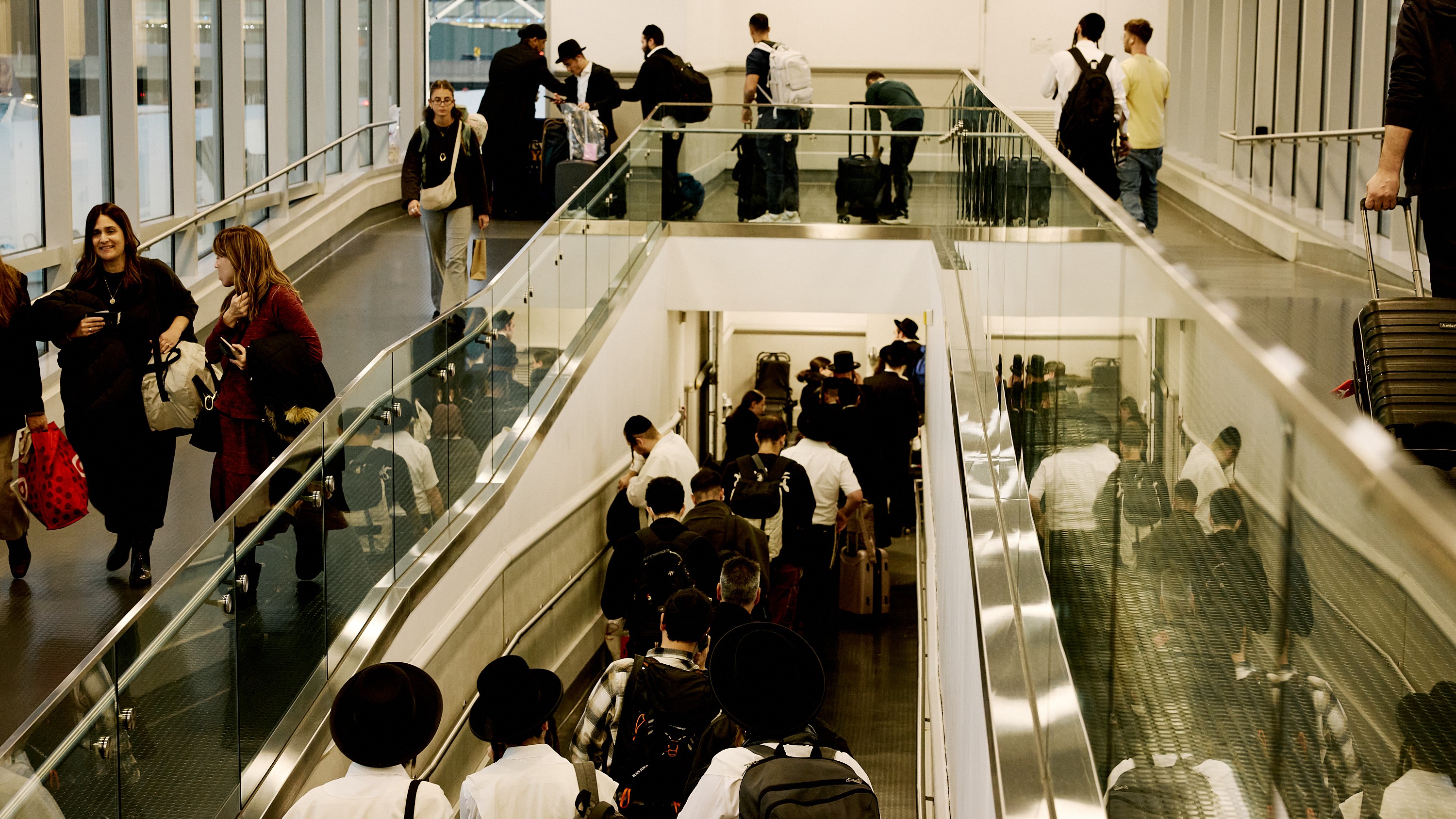
Since the onset of the Gaza war, a record number of Israelis have left their homeland, with over 10 percent of the electorate now residing abroad. The country typically does not permit absentee ballots, so those who wish to vote in today's election – the first since October 7 – must be present in person. Estimates suggest around 67,000 Israeli expatriates have traveled long distances and spent considerable sums to return home.
Within Israel, recent polls indicate a nearly balanced preference between parties backing Prime Minister Benjamin Netanyahu and those opposing him. However, most expatriates are anticipated to support the opposition.
The prime minister's allies reportedly contemplated restricting airport capacity to curb the influx of arrivals. Nevertheless, the flights proceeded. Israelis returning from abroad expressed a profound sense of engagement in this election and a conviction that its outcome will impact them regardless of their location. Many are willing to traverse great distances to cast a ballot in the belief that it will contribute to a more promising future.
Maya Mor Mitrani, a college student and opera singer in Philadelphia, expressed concern for her father, who has been on military reserve duty since October 7. "I just think the situation is really bad," she stated, "and I want to have at least some influence over how the government attempts to address the challenges we are currently facing. So if my influence equates to a single ballot in the box, that's what I'll do."
Jonathan Matkowsky, born in America and moving to Israel in 2012, barricaded his children indoors during the October 7 attack and later assisted as a volunteer driver for off-duty soldiers and civilians for four months. He returned to the United States afterward. Now, he has come back for the election: "It's a meaningful vote for me because of the immense trauma we've experienced," he explained.
While he initially considered voting for Gadi Eisenkot due to his support for extending the military draft to ultra-Orthodox individuals, he ultimately decided to vote for Netanyahu. Matkowsky trusts the prime minister's wisdom and experience and credits him with maintaining Israel's safety: "I'm proud of him. I believe in him. I think he's a hero."
New York's John F. Kennedy airport on October 25th, 2026, saw a significant turnout of expatriate voters. Dana Golan for The Atlantic An organization called Fly&Vote coordinated for expats to fly from New York to Tel Aviv on October 25th. Shirily Bar-Or, who had spent years protesting in Israel before relocating to Athens last year, expressed a desire for the country to "be sane again.
I want a government that works for the public good. I want democracy." Bar-Or believes Netanyahu seeks to "destroy us just to save his own skin."
Dan Galezer lives in New York and had planned a trip to Israel, but altered his flight to be present on Election Day. He expressed uncertainty about which opposition party to support but emphasized his desire to "get Bibi out of the seat already. His time is up." Galezer's family's kibbutz was the site of one of the most devastating massacres on October 7.
"Even after everything that's happened, I don't rule out returning," he said, "but whether that will be possible depends on the election's outcome. This feels like a breaking point."
Arie Deizer, residing in Bucharest for 30 years, compared Netanyahu to Hungarian strongman Viktor Orbán, stating that Netanyahu "has destroyed the country—he's completely lost it now," and hopes he will be "thrown out, just like Orbán." Deizer intends to vote for the Democrats, partly because unlike many other opposition parties, they have not ruled out collaborating with Arab parties if they win. "I hope we'll have an overwhelming majority here—70 seats—so that the Arab parties can't be ignored."
A sign at a shop in Jaffa, Tel Aviv, reads, "Jews and Arabs refuse to be enemies." Shai Sinai, who has not lived in Israel for 40 years, returned from Hamburg to vote in every election since Netanyahu's ascension to power. "I was born here, I grew up here, I was educated here, I served in the army here, and my entire family—members who are still alive—essentially live here," he noted.
Volunteers from Fly&Vote, a nonprofit dedicated to assisting expats in voting, met him and other voters at the airport. Democrats, a party Sinai said he would support, greeted these voters upon their arrival. Election posters at a Tel Aviv polling station featured a campaign from Naftali Bennett's B Yachad party that read, "Together We Will Fix."
Written by urgent.news from The Atlantic's reporting — not their text. Machine-written — may contain errors; check the original before relying on it.