Dead Planets Orbiting a Dead Star
When a star like our Sun reaches its end, it becomes a kind of zombie star called a white dwarf. These bodies have left fusion behind and will radiate only remnant heat for a long, long time. Before they become white dwarfs, they expand, engulf, and destroy any nearby planets. Astronomers have spotted a debris disk around a white dwarf, made from the dust of destroyed planets. Observations show…
As stars exhaust their fuel, they undergo a dramatic transformation into white dwarfs. For most stars, the end is a supernova, but our Sun will expand and cast off its outer layers, becoming a planetary nebula. Only a hot, dense cinder known as a white dwarf remains. This final stage will persist indefinitely until the white dwarf cools into a black dwarf, a state not yet realized in the Universe's history.
When white dwarfs expand, they engulf and destroy inner planets. Our Sun will likely eliminate Mercury, Venus, and Earth in this process. Observations of planetary nebulae, often clusters of white dwarfs, reveal disks of material left behind by the planets that once orbited them. Some astronomers speculate that planets can form anew from this debris around dying stars.
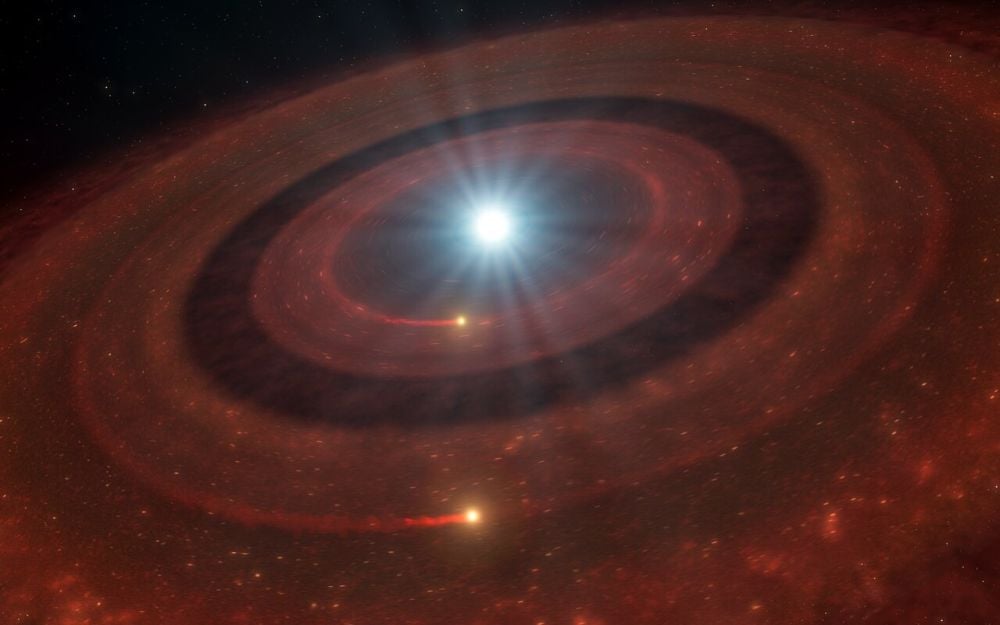
Recently, astronomers discovered a white dwarf surrounded by a double debris disk, suggesting the possibility of two surviving planets. This system, named WD J132800.85–145019.95, is described in a paper titled "A double debris disc around a white dwarf sculpted by two planetary bodies" published in Nature Astronomy. The lead author is Nicola Gentille Fusillo, an astronomer at the Università degli Studi di Trieste in Italy.
The researchers found that the white dwarf exhibits quadruple-peaked line profiles in its spectrum, indicating the presence of two separate gaseous rings extending from 0.14 to 0.34 and 0.54 to 1.93 times the radius of the white dwarf. These rings likely represent the remnants of two planetesimals or small planets orbiting the white dwarf.
One ring appears to contain a planetesimal embedded within it, which generates gas through collisions with dust particles. The other ring might represent the aftermath of a collision between two planetesimals. If confirmed, this discovery would provide rare insight into the violent, chaotic processes that occur during the end of a star's life and hint at the complex disc structures that can form around dead stars.
Written by urgent.news from Universe Today's reporting — not their text. Machine-written — may contain errors; check the original before relying on it.