A Deep-Mantle Garnet Might Hold the Secret to Ancient Martian Magma
A history of a planet’s volcanic activity is contained in its rocks. And Mars’ rocks - or at least many of the meteorites that have made the journey from it to Earth - were telling a contradictory story. They appeared to be highly oxidized, but our understanding of the internal volcanic forces on Mars meant that they should have been formed in a reducing environment - the exact opposite of what…
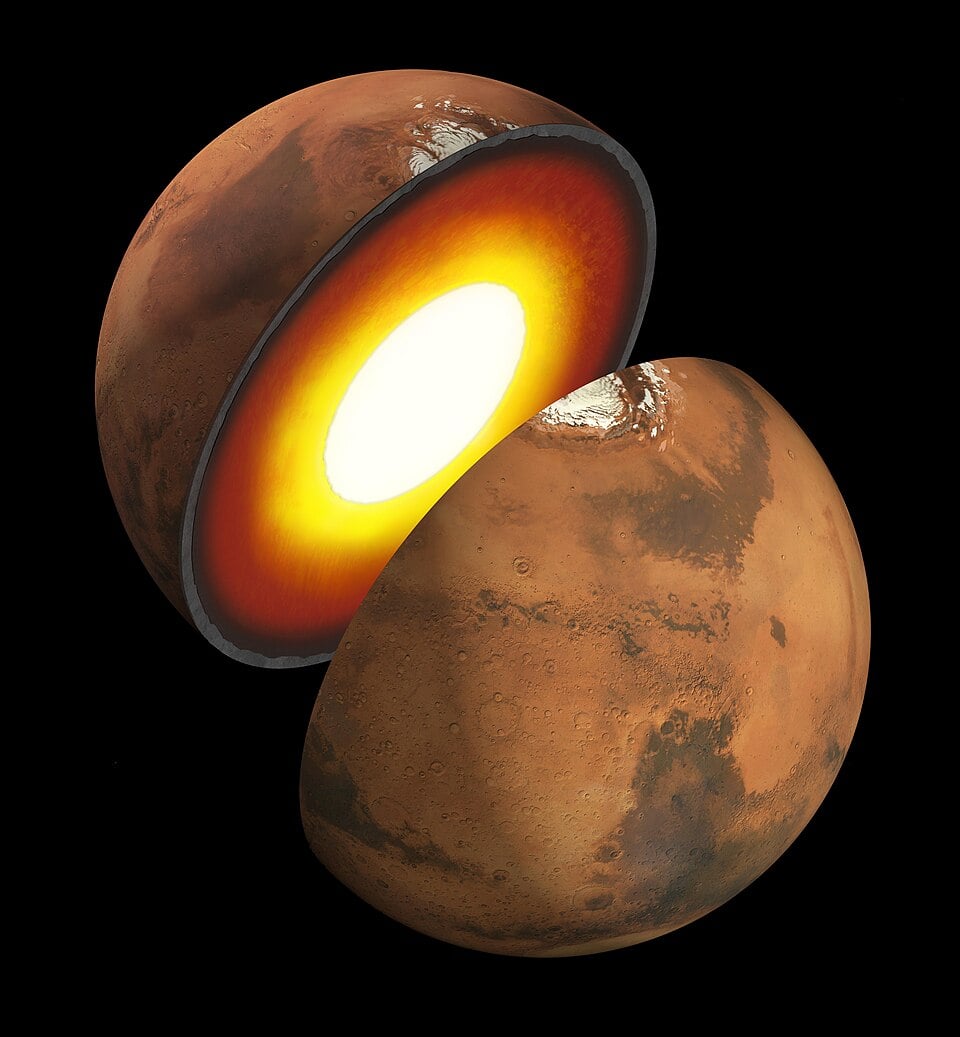
Researchers from Ehime University have discovered that a deep-mantle garnet, called majorite, may explain the contradictory chemical makeup of rocks found on Mars. These rocks appear to be highly oxidized, yet they should have formed in a reducing environment based on our understanding of Mars' internal volcanic forces. The key lies in the unique properties of majorite, a type of garnet that forms under immense pressures and temperatures deep within planetary mantles.
Mars' internal history reveals that its heavy metals initially formed an iron-rich core, akin to Earth's, creating a reducing environment. However, the oxidation of rocks on Mars and meteorites from the planet also indicates a different past. The researchers hypothesized that majorite, formed at pressures around 18 gigapascals deep within Mars' mantle, could be the reason for this contradiction.
To validate their hypothesis, the scientists subjected synthetic Martian rock to conditions similar to those in majorite's formation environment, using a hydraulic press and a synchrotron facility. They found that majorite acted as an iron sponge, absorbing oxidized ferric iron from its surroundings. This absorption reduced the overall iron content in the surrounding silicates, which explains the contradiction between the rocks' oxidized appearance and the expected reducing environment.
This discovery has implications for both Mars and Earth's internal workings. On Earth, the mantle transition from bridgmanite to majorite releases ferric iron, oxidizing the mantle's transition zone. Thus, this study bridges the gap between the chemical signatures found in meteorites and the behavior of crystals under pressure in the presence of molten metal.
Written by urgent.news from Universe Today's reporting — not their text. Machine-written — may contain errors; check the original before relying on it.